
Magnes Rare Earths' First RC Results Return 29 m at 0.58% TREO to 60 m Depth; Auger Hole Returns 15 m From Surface at 1.15% TREO
Five of seven RC holes return 7-29 m intervals at 0.53%-0.77% TREO to EOH; two deep five-metre intervals exceed 0.90% TREO and 0.23% MREO
at 1.15% TREO
MAV_AD_0375
at 0.58% TREO
to 60 m EOH
HREO over 5 m
including 100 ppm DyTb
holes
3,628.8 metres
Head-grade assays from drilled intervals. True thickness has not been determined. Selected results do not establish recovery, continuity, a mineral resource, mineral reserve, project economics or a development decision.
BELO HORIZONTE, Brazil and SINGAPORE, September 8, 2026
Magnes Rare Earths ("Magnes"), a wholly owned subsidiary of Verde AgriTech Ltd. (TSX: NPK | OTCQX: VNPKF) ("Verde" or the "Company"), is pleased to report additional head-grade rare earth assay results from 146 drill holes totalling 1,299 assayed metres at the Minas Americas Global Alliance project ("Minas Americas" or the "Project") in Minas Gerais, Brazil. The results comprise 139 completed auger holes totalling 1,027 m and the first seven completed or reconciled reverse-circulation ("RC") holes comprising 272 assayed metres.
The new auger results are led by MAV_AD_0375, the highest-grade full-hole, from-surface interval reported at Minas Americas to date. The hole returned 15 m from surface to the end of hole ("EOH") averaging 11,480 parts per million ("ppm") total rare earth oxides ("TREO"), or 1.15% TREO, and 2,830 ppm magnetic rare earth oxides ("MREO"), comprising 2,752 ppm NdPr oxides and 79 ppm DyTb oxides. MREO represents 24.7% of TREO in the interval. Within the continuous 15 m profile, one metre from 12 m to 13 m returned 19,952 ppm TREO (2.00% TREO) and 5,909 ppm MREO.
The first RC results add a new vertical dimension to the drill-derived dataset. Five of the seven holes returned 7-29 m intervals averaging 0.53%-0.77% TREO to EOH, including four intervals at least 15 m long. MAV_RC_0012 returned 29 m from 31 m to the 60 m EOH at 5,751 ppm TREO (0.58% TREO) and 1,346 ppm MREO. Two separate five-metre intervals at depths between 38 m and 51 m exceeded 0.90% TREO and 0.23% MREO: MAV_RC_0012 returned 5 m from 38 m to 43 m at 9,106 ppm TREO, 2,315 ppm MREO and 566 ppm heavy rare-earth oxides ("HREO"), including 100 ppm DyTb oxides; MAV_RC_0005 returned 5 m from 46 m to 51 m at 9,191 ppm TREO, 2,429 ppm MREO and 430 ppm HREO, including 91 ppm DyTb oxides.
"Today's results give us the strongest combination yet of near-surface grade, depth and magnet rare-earth content at Minas Americas. Fifteen metres at 1.15% TREO from surface establishes a new full-hole benchmark for the Project. Just as importantly, our first RC drilling has identified multiple broad, higher-grade intervals far below the reach of the auger program. Five of seven RC holes carry intervals grading between 0.53% and 0.77% TREO to their current depth limits, including 29 metres at 0.58% TREO to the bottom of a 60-metre hole. The heavy rare-earth component is also emerging in both shallow and deeper drilling, led by 5 metres at 566 ppm HREO, including 100 ppm dysprosium-plus-terbium oxides, in MAV_RC_0012."
"Rare-earth projects will ultimately be judged on recoverable magnet products, not head grade alone. The next value-defining work is to test beneath these current depth limits, connect the expanded dataset in three dimensions and determine recoveries from representative drill composites. With 443 holes and more than 3.6 kilometres of reported assays, Minas Americas now has a substantially stronger platform for that work and for the planned maiden mineral resource estimate."
Prior to this release, Magnes had reported assay results from 297 auger holes totalling 2,329.8 m at Minas Americas. This release adds 139 auger holes totalling 1,027 m and seven RC holes comprising 272 assayed metres, for 146 holes and 1,299 m. Cumulative reported assay drilling now totals 443 holes and 3,628.8 m.
From-surface grade, broad RC intervals and a quantified heavy rare-earth component.
- Highest-grade full-hole result reported to date. MAV_AD_0375 returned 15 m from surface to EOH at 11,480 ppm TREO (1.15% TREO) and 2,830 ppm MREO, including one metre at 19,952 ppm TREO (2.00% TREO) and 5,909 ppm MREO.
- Broad interval at depth. MAV_RC_0012 returned 29 m from 31 m to the 60 m EOH at 5,751 ppm TREO (0.58% TREO) and 1,346 ppm MREO. No composite crosses the documented 30-31 m no-recovery interval.
- Five of seven RC holes carry elevated grades to EOH. Five holes returned 7-29 m intervals averaging 5,258-7,744 ppm TREO (0.53%-0.77% TREO) to their current depth limits, including four intervals at least 15 m long. Mineralisation below current EOH depths remains untested.
- Two deep intervals above 0.90% TREO and 0.23% MREO. MAV_RC_0005 returned 5 m from 46 m to 51 m at 9,191 ppm TREO and 2,429 ppm MREO; MAV_RC_0012 returned 5 m from 38 m to 43 m at 9,106 ppm TREO and 2,315 ppm MREO.
- Broad mineralisation from surface. MAV_RC_0007 intersected 27 m from surface to EOH at 5,258 ppm TREO (0.53% TREO) and 1,207 ppm MREO, including 10 m from 7 m to 17 m at 8,215 ppm TREO and 1,969 ppm MREO.
- High auger grades repeat across multiple holes. Four separate auger holes returned complete, from-surface averages of 0.86%-1.15% TREO over 8-15 m. Across the full auger package, 35 of 139 holes averaged at least 4,000 ppm TREO over a combined 300 m.
- Heavy rare-earth oxides accompany high-grade TREO. MAV_RC_0012 returned 5 m at 566 ppm HREO, including 100 ppm DyTb. The 272 assayed RC metres average 145.5 ppm HREO, including 29.8 ppm DyTb.
- Elevated grades at current depth limits. Six of the seven RC holes returned more than 4,000 ppm TREO in their final assayed metre, identifying targets for deeper follow-up drilling.
- Cumulative scale. Reported assay drilling at Minas Americas now stands at 443 holes and 3,628.8 m.
The 4,000 ppm and 7,000 ppm thresholds are used only to summarise assay results and are not mineral-resource cut-off grades or economic thresholds.
Broad intervals from surface and at depth.
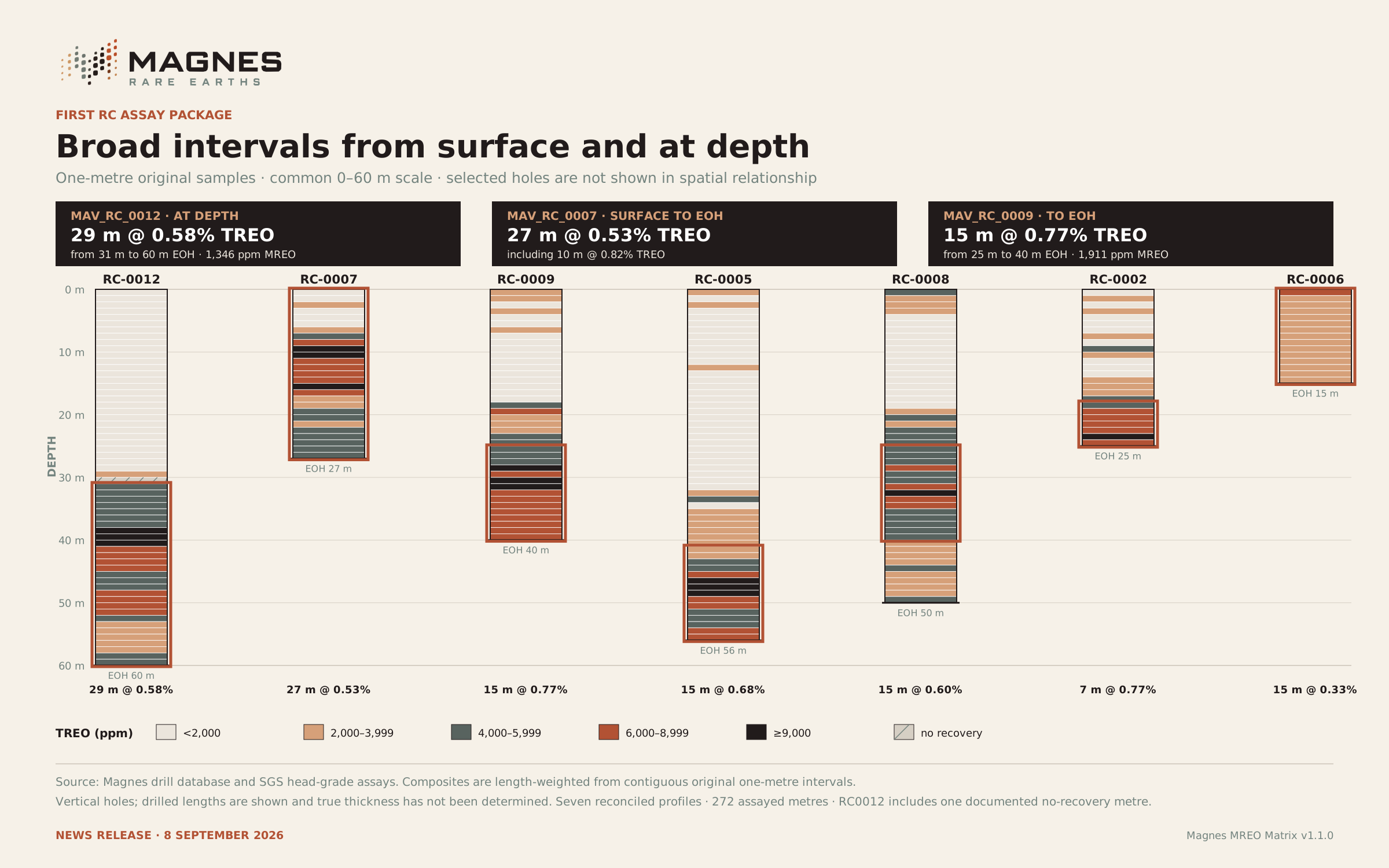
The first RC assays extend the drill-derived dataset below auger depths.
In MAV_RC_0012, the 29 m lower interval below the documented no-recovery gap averages 5,751 ppm TREO and 1,346 ppm MREO to 60 m, more than eight times the TREO grade and ten times the MREO grade of the upper 30 assayed metres.
Five of seven RC holes returned elevated intervals to EOH and six ended above 4,000 ppm TREO in their final assayed metre, creating specific deeper-drilling targets. Comparable grades below current EOH depths and continuity between holes remain untested.
Head grades quantify all four magnet oxides.
Neodymium, praseodymium, dysprosium and terbium are the four elements represented by the oxide-equivalent MREO measure and are used in high-performance permanent magnets. The International Energy Agency's 2026 Rare Earth Elements report estimates that permanent magnets account for approximately 95% of global rare-earth consumption by value and that demand for these four elements is set to grow by a further one-third by 2030 under current policy settings.
Across 272 assayed RC metres, MREO averages 828 ppm, or 22.8% of TREO, led by 798 ppm NdPr with 29.8 ppm DyTb. MAV_AD_0375 averages 2,830 ppm MREO (0.28%); the two deep five-metre RC intervals average 2,315 ppm and 2,429 ppm MREO.
Earlier leach tests indicated ionic adsorption behaviour. These results are head grades and do not establish desorbability or recovery. Representative drill-based metallurgical testwork is the next major test of how the magnet-oxide grades may translate into a recoverable product.
Source: International Energy Agency, Rare Earth Elements (2026).
Heavy rare-earth oxides: the dysprosium-terbium magnet subset.
Beyond the strong TREO and MREO results, the assays quantify a distinct heavy rare-earth component. MAV_RC_0012 returned 5 m from 38 m to 43 m averaging 566 ppm HREO, including 100 ppm combined Dy2O3 and Tb4O7. Heavy rare-earth oxides were present in the final assayed metre of every RC hole, ranging from 118 ppm to 345 ppm HREO and from 26 ppm to 75 ppm DyTb.
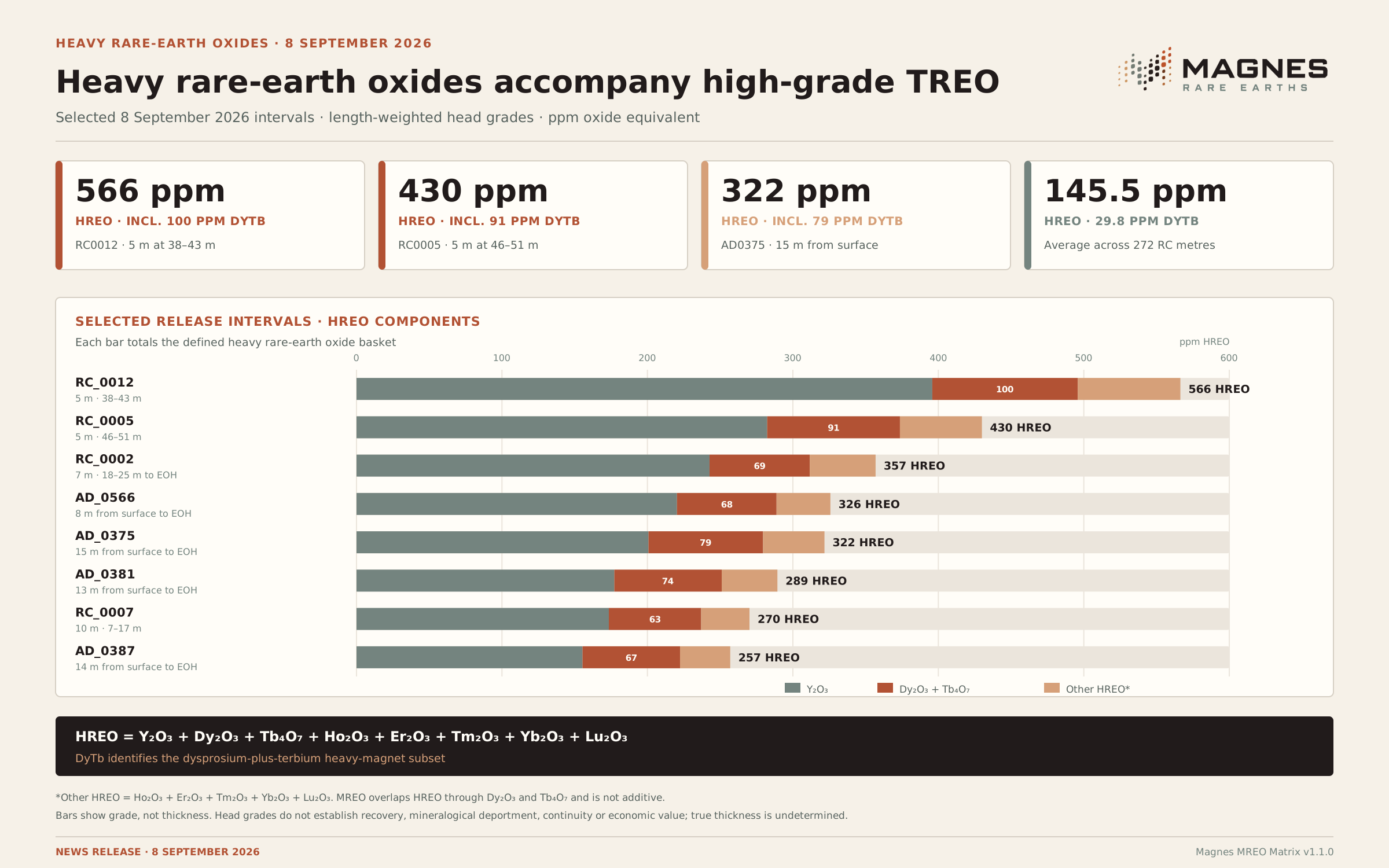
For this release, HREO is defined as the sum of Y2O3, Dy2O3, Tb4O7, Ho2O3, Er2O3, Tm2O3, Yb2O3 and Lu2O3. DyTb is the combined Dy2O3 and Tb4O7 heavy-magnet subset. MREO overlaps HREO through Dy2O3 and Tb4O7 and the two metrics are not additive. Representative metallurgical testing is required to determine recoverability.
Selected auger and RC hole-level results.
| Hole | From (m) | To (m) | Interval (m) | TREO (ppm) | TREO (%) | MREO (ppm) | MREO/TREO | NdPr (ppm) | DyTb (ppm) |
|---|---|---|---|---|---|---|---|---|---|
| Full-hole compositeMAV_AD_0375 | 0 | 15 EOH | 15 | 11,480 | 1.15% | 2,830 | 24.7% | 2,752 | 79 |
| Full-hole compositeMAV_AD_0381 | 0 | 13 EOH | 13 | 9,380 | 0.94% | 2,555 | 27.2% | 2,481 | 74 |
| Full-hole compositeMAV_AD_0387 | 0 | 14 EOH | 14 | 8,930 | 0.89% | 2,275 | 25.5% | 2,208 | 67 |
| Full-hole compositeMAV_AD_0566 | 0 | 8 EOH | 8 | 8,565 | 0.86% | 1,999 | 23.3% | 1,930 | 68 |
| Full-hole compositeMAV_AD_0418 | 0 | 6 EOH | 6 | 6,627 | 0.66% | 1,601 | 24.2% | 1,547 | 55 |
| Full-hole compositeMAV_AD_0447 | 0 | 14 EOH | 14 | 6,195 | 0.62% | 1,390 | 22.4% | 1,343 | 47 |
Complete hole-level results and drill-collar information are intended for the separate annex to the 8 September 2026 news release. The annex is not part of this website package.
| Hole | From (m) | To (m) | Interval (m) | TREO (ppm) | TREO (%) | MREO (ppm) | MREO/TREO | NdPr (ppm) | DyTb (ppm) |
|---|---|---|---|---|---|---|---|---|---|
| Upper intervalMAV_RC_0012* | 0 | 30 | 30 | 705 | 0.07% | 131 | 18.6% | 125 | 6 |
| Lower intervalMAV_RC_0012* | 31 | 60 EOH | 29 | 5,751 | 0.58% | 1,346 | 23.4% | 1,294 | 52 |
| IncludingMAV_RC_0012* | 31 | 45 | 14 | 6,636 | 0.66% | 1,561 | 23.5% | 1,495 | 66 |
| IncludingMAV_RC_0012* | 38 | 43 | 5 | 9,106 | 0.91% | 2,315 | 25.4% | 2,215 | 100 |
| Full-hole compositeMAV_RC_0007 | 0 | 27 EOH | 27 | 5,258 | 0.53% | 1,207 | 23.0% | 1,164 | 43 |
| IncludingMAV_RC_0007 | 7 | 17 | 10 | 8,215 | 0.82% | 1,969 | 24.0% | 1,906 | 63 |
| Full-hole compositeMAV_RC_0009 | 0 | 40 EOH | 40 | 4,295 | 0.43% | 1,004 | 23.4% | 970 | 33 |
| IncludingMAV_RC_0009 | 25 | 40 EOH | 15 | 7,744 | 0.77% | 1,911 | 24.7% | 1,851 | 60 |
| Full-hole compositeMAV_RC_0005 | 0 | 56 EOH | 56 | 2,971 | 0.30% | 655 | 22.0% | 630 | 24 |
| IncludingMAV_RC_0005 | 41 | 56 EOH | 15 | 6,750 | 0.68% | 1,675 | 24.8% | 1,616 | 59 |
| IncludingMAV_RC_0005 | 46 | 51 | 5 | 9,191 | 0.92% | 2,429 | 26.4% | 2,337 | 91 |
| Full-hole compositeMAV_RC_0008 | 0 | 50 EOH | 50 | 3,502 | 0.35% | 810 | 23.1% | 782 | 29 |
| IncludingMAV_RC_0008 | 25 | 40 | 15 | 6,018 | 0.60% | 1,450 | 24.1% | 1,400 | 50 |
| Full-hole compositeMAV_RC_0002 | 0 | 25 EOH | 25 | 3,763 | 0.38% | 847 | 22.5% | 817 | 30 |
| IncludingMAV_RC_0002 | 18 | 25 EOH | 7 | 7,652 | 0.77% | 1,898 | 24.8% | 1,829 | 69 |
| Full-hole compositeMAV_RC_0006 | 0 | 15 EOH | 15 | 3,255 | 0.33% | 741 | 22.8% | 716 | 25 |
* MAV_RC_0012 assay coverage comprises 0-30 m and 31-60 m. The 30-31 m interval was not recovered and therefore has no assay result. No composite crosses the gap. Intervals are length-weighted averages of contiguous, original one-metre samples.
443 holes and 3,628.8 assayed metres reported cumulatively.
| Reporting period | Drill type | Holes | Assayed metres |
|---|---|---|---|
| Reported before this release | Auger | 297 | 2,329.8 |
| Present release | Auger | 139 | 1,027.0 |
| Present release | RC | 7 | 272.0 |
| Present release subtotal | Auger + RC | 146 | 1,299.0 |
| Cumulative reported total | Auger + RC | 443 | 3,628.8 |
The previously reported total comprises 44 initial auger holes totalling 473.8 m and 253 additional auger holes totalling 1,856 m announced on 16 June 2026. Each hole is counted once. The RC metre total counts original drill intervals for which assays are reported; the documented one-metre no-recovery interval in MAV_RC_0012 is excluded.
From shallow discovery to three-dimensional definition.
Minas Americas is an exploration-stage clay-hosted rare earth project across 13 mineral rights in Minas Gerais, Brazil. Surface and trench sampling returned up to 8,930 ppm TREO and 2,182 ppm MREO before drilling commenced. Initial leach tests indicated ionic adsorption behaviour, with up to 667 mg/kg desorbable rare earth oxides ("DREO") and up to 278 mg/kg MREO in primary leach solution.
With 443 holes and 3,628.8 m of reported assays, Minas Americas is progressing from a shallow auger discovery toward three-dimensional geological definition. The first RC results materially increase the vertical range of the dataset, identify priority targets below current EOH depths and provide drill-derived material to support representative metallurgical composite selection.
Minas Americas has no mineral resource, mineral reserve, project economics or development decision. The next value-defining questions are whether deeper and follow-up drilling reproduces the elevated intervals, how the shallow and deeper profiles connect in the geological model and how representative mineralised material performs in controlled metallurgical testwork.
The work required to test continuity, recovery and economic potential.
- Integrate the expanded auger and RC assay dataset into the three-dimensional geological model.
- Conduct priority follow-up RC drilling around the principal broad, higher-grade intervals and beneath selected holes with elevated TREO in their final assayed metre.
- Select representative drill-based composites and advance metallurgical testwork.
- Continue resource-definition and step-out drilling, reporting additional holes only after assay coverage is complete or reconciled and applicable QA/QC review is closed.
- Target maiden S-K 1300 and NI 43-101 mineral resource estimates before the end of 2026, subject to drilling results, assay turnaround, technical work and regulatory review.
- Target a preliminary economic assessment in H1 2027, subject to completion of the required resource, metallurgical, engineering and economic work.
- Continue strategic development and capital-markets preparation, including the intended U.S. listing process if conditions and approvals support it.
Definitions, calculation boundaries and sample coverage.
Assays are reported as head grades in ppm. 10,000 ppm equals 1.0%. TREO means the sum of the oxides of lanthanum through lutetium plus yttrium. MREO means the sum of Nd2O3, Pr6O11, Dy2O3 and Tb4O7. HREO means the sum of Y2O3, Dy2O3, Tb4O7, Ho2O3, Er2O3, Tm2O3, Yb2O3 and Lu2O3. NdPr means the sum of Nd2O3 and Pr6O11. DyTb means the sum of Dy2O3 and Tb4O7. MREO and HREO overlap through Dy2O3 and Tb4O7 and are not additive. DREO, where prior leach testing is referenced, means desorbable rare earth oxides.
Selected composites are length-weighted averages of contiguous, original one-metre drill-interval samples. Summary calculations use head-grade assay values. For calculation purposes, values reported below a detection limit were assigned one-half of that limit, while values reported above an upper reporting limit were assigned the stated limit. Rounding may result in minor differences.
Auger and RC samples represent one-metre drilled intervals. Drill-interval calculations exclude QA/QC, duplicate and other control samples. All reported auger and RC holes were drilled vertically, with a dip of -90 degrees; azimuth is not applicable to vertical holes. Reported intervals are drilled lengths; true thickness has not been determined. Spatial coordinates are referenced to SIRGAS 2000 and projected using UTM Zone 23S.
Six of the seven RC holes have continuous assay coverage from surface to EOH. MAV_RC_0012 contains a documented no-recovery interval from 30 m to 31 m. No composite crosses that interval. Every included hole record has been reconciled to its recorded EOH. Incomplete holes and holes subject to an unresolved QA/QC hold are excluded from this release.
Laboratory, controls and independent verification.
Auger and RC samples were submitted to SGS Geosol Laboratorios S.A. in Vespasiano, Minas Gerais, Brazil, a third-party commercial laboratory external to Magnes and Verde. Analyses used lithium-borate fusion followed by ICP-MS/OES determination for rare earth and oxide analysis. Magnes' quality assurance and quality control procedures include the regular insertion of blanks, certified reference materials and field duplicates into the sample stream. Laboratory repeat and duplicate analyses were performed by SGS.
The Qualified Person verified the sampling, analytical and test data supporting this disclosure by reconciling drill-hole, interval, sample and batch identifiers between the field database and laboratory records; comparing analytical values, methods, units and qualifiers with the laboratory records; independently recalculating selected oxide totals and length-weighted composites; and reviewing the applicable blanks, certified reference materials, field duplicates and laboratory controls. No material discrepancies or limitations were identified during this verification. Based on the procedures performed and results obtained, the Qualified Person considers the underlying data reliable and suitable for disclosure of exploration results.
Independent technical review.
The scientific and technical information in the 8 September 2026 release was reviewed and approved by Carlos Leite, MAusIMM CP(Geo) (No. 1006695), an independent consultant to Magnes and a Qualified Person under NI 43-101.
Magnes Rare Earths and Verde AgriTech.
About Magnes Rare Earths
Magnes Rare Earths was created as a wholly owned subsidiary of Verde AgriTech Ltd. to hold and advance the Minas Americas Global Alliance Project in Minas Gerais, Brazil. Magnes is intended to serve as Verde's dedicated rare earths platform and, subject to market conditions and applicable approvals, pursue a future listing on a U.S. stock exchange.
About Verde AgriTech
Verde AgriTech is a Brazil-focused specialty fertilizer company listed on the TSX and OTCQX. Through its wholly owned subsidiary Magnes Rare Earths, the Company also retains exposure to the Minas Americas Global Alliance rare earth project in Minas Gerais, Brazil.
Important cautionary language.
This news release contains forward-looking information and forward-looking statements within the meaning of applicable securities laws. These include statements regarding the significance and interpretation of exploration results; the potential continuity, geometry, extent and depth of mineralisation; whether mineralisation continues below current EOH depths; geological modelling and target ranking; follow-up, step-out and resource-definition drilling; receipt, validation and reporting of additional assays; representative composite selection, metallurgical testwork and technical studies; the potential timing and publication of S-K 1300 and NI 43-101 mineral resource estimates and a preliminary economic assessment; the potential pursuit of a U.S. stock exchange listing for Magnes; and Magnes' and Verde's plans, objectives and expectations.
Forward-looking statements are based on management's current expectations, estimates, interpretations and assumptions, including the accuracy and representativeness of sampling and assay data; the potential continuity of mineralisation; the availability of drilling equipment, laboratories, qualified personnel and financing; timely receipt of required permits and approvals; and technical work progressing as presently anticipated. Forward-looking statements involve risks and uncertainties that may cause actual results or events to differ materially, including exploration-stage risk, assay and metallurgical variability, geological interpretation and continuity risk, sampling and QA/QC risk, mineral-right and permitting risk, commodity-market and financing risk, regulatory and exchange approvals, market conditions and other risks described in the Company's continuous-disclosure filings.
No mineral resource estimate, mineral reserve estimate, production guidance, project-level economic assessment, recovery estimate or development decision is provided in this release. There is no certainty that further exploration will delineate mineral resources or mineral reserves, that metallurgical testwork will demonstrate economic recoveries, or that a development decision will be made. Readers should not place undue reliance on forward-looking statements. Forward-looking statements speak only as of the date of this news release. Magnes and Verde do not undertake to update them except as required by applicable securities laws.