Locked inside a mineral crystal
The mineral may need crushing, concentration and chemical opening before its rare earths enter solution.
Follow the element
Two deposits can report the same headline TREO and require radically different work before a customer can buy anything. The reason begins at a smaller scale: where—and how—the rare earth is held.
Follow one magnet rare-earth element through the evidence chain.
The grade paradox
TREO measures oxide-equivalent content in the sampled material. It does not say whether the rare earth is exchangeable, recoverable, separable, payable—or economic.
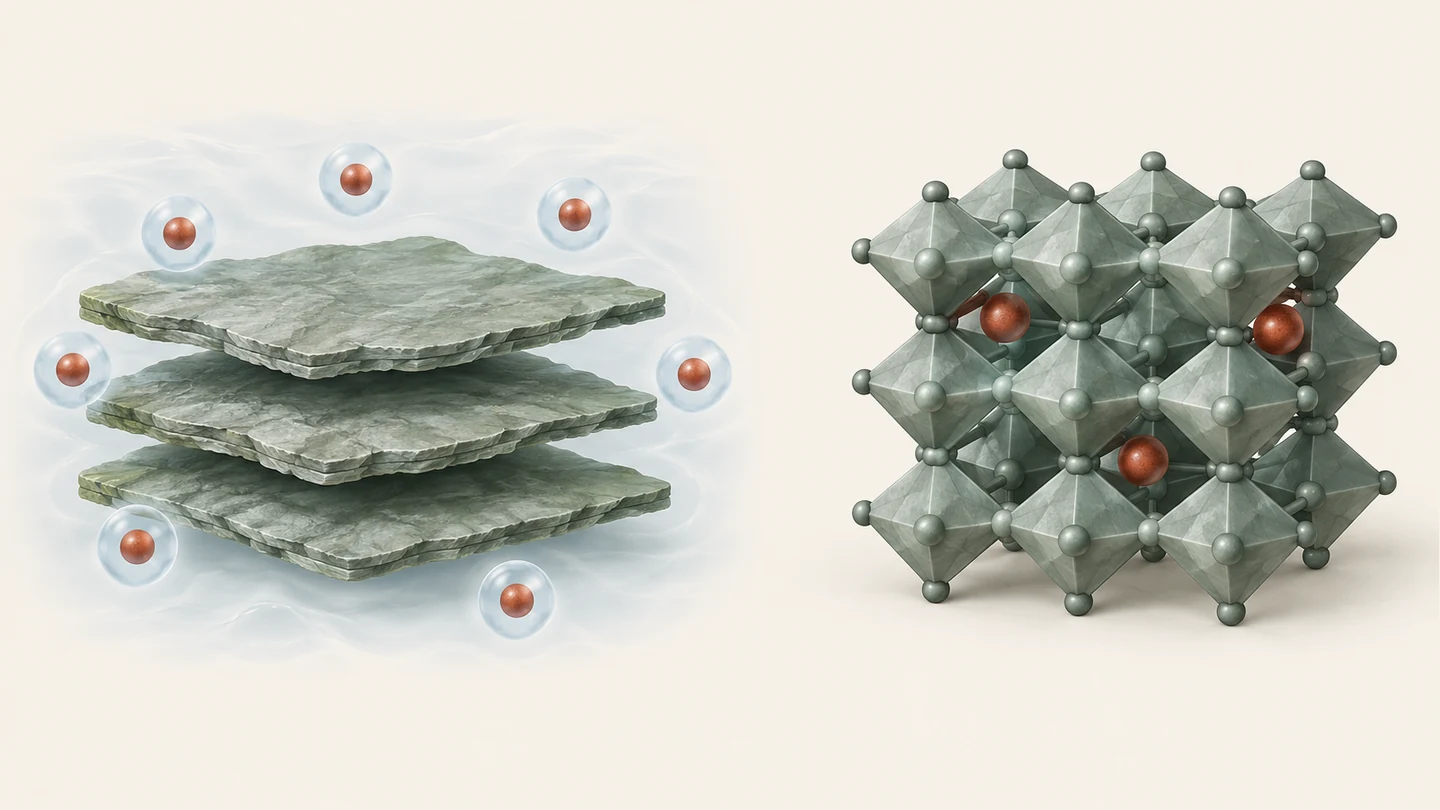
Qualitative hosting concepts, not an exact atomic structure or a Magnes mineralogical result. Markers illustrate different hosting states, not measured proportions.
The mineral may need crushing, concentration and chemical opening before its rare earths enter solution.
A mild salt may mobilise the exchangeable fraction—but only representative testing can establish how much.
Interactive field guide
Choose a family. The geological setting, binding state and front-end route will change; the downstream proof burden does not disappear.
These four commercially representative pathways are a comparison framework, not an exhaustive geological taxonomy. They deliberately connect setting with the more decisive process question: where the element resides.
Carbonatite-related ore selected.
Carbonate-rich igneous systems that can host bastnaesite, monazite and related rare-earth minerals.
The rare earth is part of a discrete mineral lattice. The mineral must first be liberated from the surrounding rock, then chemically opened before the elements can enter solution.
Investor read: Head grade can be comparatively high, but grade does not remove the need for beneficiation, chemical treatment and separation.
The front end changes with geology. After a rare-earth-bearing solution exists, every route still faces purification, product formation, separation and qualification.
Extract and prepare competent or weathered ore.
Crush, grind and concentrate the rare-earth-bearing mineral.
Use project-specific thermal or chemical treatment and leaching.
Control impurities and condition the rare-earth-bearing solution.
Precipitate or otherwise form a defined mixed intermediate.
Separate chemically similar rare earths into specified streams.
Demonstrate purity, consistency, scale and commercial acceptance.
The decisive distinction
“Clay-hosted” describes where material occurs. “Ion-adsorption” describes a binding mechanism. Confusing the two can lead investors to assume a process advantage that has not been demonstrated.
Exchangeable surface ion selected.
This is the potentially attractive ionic-clay mechanism. It must be demonstrated through representative extraction, variability and mass-balance work—not inferred from appearance or head grade.
Peer-reviewed spectroscopy has identified genuinely exchangeable rare earths as hydrated outer-sphere complexes adsorbed predominantly on kaolinite. That mechanism is the scientific basis for mild salt desorption—not the visual presence of clay alone.
Open the Nature Communications studyFive-question investment test
Every answer changes the amount of technical, capital and commercial work between geology and revenue.
Competent rock, liberated mineral sands, shallow regolith, a residue or another material stream?
Structurally bound in a mineral, naturally liberated as a grain, or exchangeable on a clay surface?
Nd and Pr, with meaningful Dy and Tb—or a larger total dominated by lower-value elements?
Mining, beneficiation, chemical treatment, purification, precipitation, separation and qualification?
Assay, selected diagnostic test, representative recovery, mass balance, pilot product, study or operating performance?
Every rare-earth project moves the difficult step. None eliminates it.
Representative project atlas
One company can own several geological styles. These source-dated examples illustrate routes and stages; they are not rankings, peer scores or statements of relative value.
8 representative projects shown · source-reviewed 13 August 2026
MP Materials · California, United States
Bastnaesite-bearing carbonatite; mining, beneficiation, separation and refining are operating at the site.
Open primary project source (opens in a new tab)Reviewed 7 Aug 2026Critical Metals Corp. (92.5%) · Southern Greenland
A peralkaline igneous REE-Zr deposit hosted by the Ilímaussaq Alkaline Complex; the owner reports it at the exploration and evaluation stage.
Open primary project source (opens in a new tab)Reviewed 13 Aug 2026Astron / Energy Fuels JV · Victoria, Australia
A fine-grained heavy-mineral-sands deposit with zircon, titanium minerals and a rare-earth mineral concentrate route.
Open primary project source (opens in a new tab)Reviewed 7 Aug 2026SVRE Holdings / Serra Verde · Goiás, Brazil
The plant has produced and sold mixed rare-earth carbonate; current disclosures describe commissioning, ramp-up and optimisation.
Open primary project source (opens in a new tab)Reviewed 7 Aug 2026Aclara Resources · Goiás, Brazil
An ionic-clay project with a filed feasibility study, environmental review and completed semi-industrial pilot campaign.
Open primary project source (opens in a new tab)Reviewed 7 Aug 2026Meteoric Resources · Minas Gerais, Brazil
A resource- and reserve-defined ionic-clay development project with PFS-level process and economic work.
Open primary project source (opens in a new tab)Reviewed 7 Aug 2026Ionic Rare Earths · Uganda
A licensed ionic-clay project with Stage 1 DFS work and mixed rare-earth carbonate produced at demonstration scale.
Open primary project source (opens in a new tab)Reviewed 7 Aug 2026Magnes Rare Earths · Minas Gerais, Brazil
Shallow clay-hosted mineralisation with ionic behaviour observed in selected diagnostic tests; representative recovery is not established.
See the project evidenceReviewed 7 Aug 2026Iluka’s Eneabba monazite stockpile and other secondary streams can be commercially important, but they should not be classified as geological deposit families. Their advantage is a different starting point in the value chain; they still require a defined chemical and separation route.
See the Eneabba exampleMinas Americas evidence overlay
Minas Americas is shallow and clay-hosted, with ionic-adsorption behaviour observed in selected initial diagnostic tests. Representative mineralogy, extraction, mass balance and product work are future evidence gates.
EXPLORATION STAGE · 6 OCTOBER UPDATE · 25 SEPTEMBER DATA CUTOFFThe supplied 16 June 2026 disclosure describes shallow, clay-hosted rare-earth mineralisation at Minas Americas.
The combined assay compilation covers 879 holes and 7,468.8 assayed metres at the 25 September 2026 cutoff. It includes prior results and complete or partial assay coverage; it is not all-new drilling or gross physical drilling.
Initial selected-sample tests reported desorbable rare earths in solution under stated laboratory conditions. Dated, narrowed source quotation only. The results do not establish representative recovery, an optimised flowsheet, product specifications or economics. Sample/result reconciliation and representative metallurgical work remain outstanding.
SGS bench work covers seven geological samples from four auger holes plus one quality-control duplicate. Leach liquor, two separately analysed washes and residue were tested. Reporting of the SGS bench-scale results is the next milestone, after results reconciliation and technical review. No numerical results from this programme are disclosed here. An optimised flowsheet and commercial recovery have not been established; timing and outcomes are not guaranteed.
Reconcile feed, solution, residue, losses, water, reagents and impurities before defining a process route.
Demonstrate a specified intermediate, separation interface, customer relevance and—only later—project economics.
Nature may simplify part of the front end. It does not create a product.
Read the metallurgy evidence Read the dated results and limitationsSources and limits
Deposit-family descriptions are general educational frameworks. Real mineralogy and process circuits vary by project. Project examples are representative, source-dated and unranked. Magnes-specific statements are limited to the cited disclosures.
Conventional deposit framework used as the geological starting point for this comparison.
Peer-reviewed evidence for hydrated outer-sphere complexes adsorbed on clay surfaces.
A generalised downstream framework; real circuits remain ore- and project-specific.
Selected head-grade drilled intervals are not a mineral resource, reserve, recovery estimate or economic result. True thickness has not been determined. MAV_RC_0012 includes a documented 30-31 m no-recovery interval, and no composite crosses that gap. The separate Drill-Hole and Assay Results Annex referred to in the release is not included in this website package.
The narrative thorium shorthand conflicts with the numerical table. The website uses the Table 2 values reconciled against SGS certificate GQ2509212. Solution concentrations are not recovery percentages, a representative flowsheet, a project-wide radiological profile or evidence of economic extraction.
Magnes investor updates
Receive public company announcements, technical updates and new presentations by email.
Confirm your email to subscribe. Unsubscribe at any time.