
A 25-centimetre robot duck that waddles, falls over, gets back up and roller-skates sounds like peak internet absurdity. It is also a surprisingly useful way to understand the next chapter of rare earths in robotics.
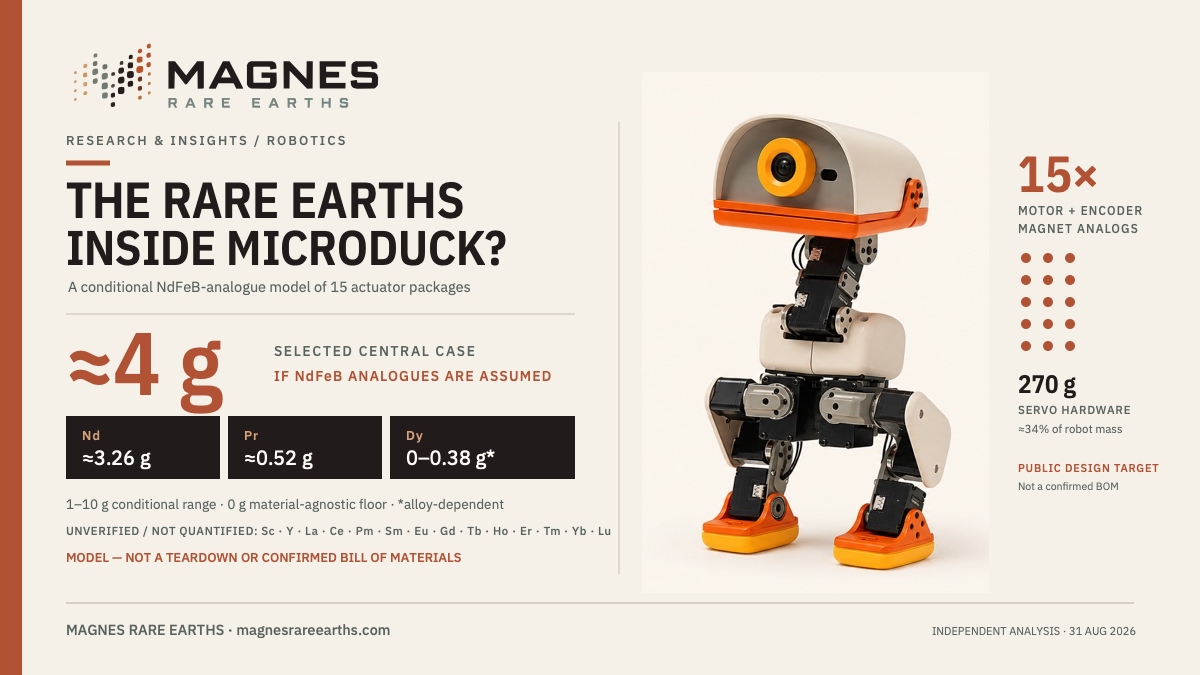
Under a conditional NdFeB-analogue model applied to the public pre-order configuration, the selected central case is approximately 4 grams of magnet-bound rare-earth elements—principally neodymium and praseodymium, with dysprosium possible depending on alloy grade. The deliberately broad conditional range is approximately 1–10 grams.
No public source reviewed confirms that Microduck's installed motor, encoder or speaker magnets are NdFeB, or discloses their chemistry, grade or mass. Zero is therefore the material-agnostic floor. The approximately 1–10 g range—and approximately 4 g selected central case—apply only to the stated NdFeB-analogue model. The central case is not an observed or probability-weighted estimate.
Four grams sounds immaterial. That is exactly why the duck matters. At one million Microduck-equivalent units, four grams becomes four tonnes. At 100 million, it becomes 400 tonnes. At one billion, it becomes 4,000 tonnes. A robotics demand layer does not require every machine to contain a huge magnet; it requires large numbers of machines containing many compact motion systems.
1. A tiny robot with an industrial materials story
Pollen Robotics' press kit describes Microduck as a 25 cm biped with 15 motors, a camera, an 8×8 time-of-flight depth sensor, two inertial measurement units, microphones, a speaker and a removable battery. It weighs under 800 g and opened for pre-order on 27 August 2026 at an introductory price of US$399. Pollen says several specifications remain provisional.
The materials interest sits in its movement system. Pollen's pinned control-loop design places 15 servos and an IMU board on one DYNAMIXEL bus. The public software and pinned robot model reference the ROBOTIS XL330 family. ROBOTIS specifies both listed XL330 variants at 18 g, with a cored motor and AS5601 contactless magnetic encoder.
If the public 15-unit XL330-family configuration carries into production, the complete servo packages would total about 270 g—more than one-third of the robot's stated upper-bound mass. That does not prove the magnets are NdFeB, nor disclose their grade or mass. It explains why the actuator packages deserve scrutiny.
2. How the conditional model reaches approximately 4 g
There is no public production bill of materials, magnet supplier declaration or physical teardown for Microduck. The screen therefore tests three possible magnet-bearing allocations, not a count of confirmed rare-earth magnets.
Scroll the table horizontally to read all columns.
| Modelled allocation | Count | Public basis |
|---|---|---|
| Motor-field allocation | 15 | One cored motor inside each XL330-family servo |
| Encoder-target allocation | 15 | One AS5601 magnetic position-encoder system per servo |
| Speaker allowance | 1 | The published product specification includes a speaker |
The central case represents each encoder with the D6×2.5 mm magnet geometry in an ams OSRAM design guide. It is a reference design—not evidence of the magnet installed inside XL330. Using a 7.5 g/cm³ NdFeB density gives 0.530 g for that reference magnet. Each motor receives a 0.360 g field-magnet allowance, based on a 6 g motor subassembly and 6% magnet fraction; the speaker receives 0.300 g. These are explicit analogical assumptions.
The bridge is reproducible: [15 × (0.530 g + 0.360 g) + 0.300 g] × 28.8% = 3.9312 g. The 28.8% conversion uses a measured compact-electronics magnet proxy comprising 23.9% Nd, 3.8% Pr and 1.1% Dy. It is not a Microduck alloy assay.
Scroll the table horizontally to read all columns.
| Element | Conditional central output | Evidence treatment |
|---|---|---|
| Neodymium (Nd) | ≈3.26 g | Conditional model output if NdFeB |
| Praseodymium (Pr) | ≈0.52 g | Conditional model output if NdFeB |
| Dysprosium (Dy) | ≈0.15 g proxy central; 0–0.38 g sensitivity | Possible; alloy-dependent |
| Terbium (Tb) | Not added | Unverified |
| Other rare earths | Not quantified | Unverified |
| Named magnet-bound REEs | ≈3.93 g central; ≈1.05–9.88 g envelope | Rounded to ≈4 g; ≈1–10 g |
The figures are elemental masses, not rare-earth-oxide equivalents. Dy-free NdFeB grades exist, so dysprosium begins at zero. Pollen's three-motor joint patent family was checked for context, but its different architecture was not used to set the estimate.
3. Duckonomics: when grams become tonnes
The multiplication is simple. Its implications are not.
Scroll the table horizontally to read all columns.
| Equivalent units | Rounded central case | Conditional 1–10 g range |
|---|---|---|
| 1 million | 4 tonnes | 1–10 tonnes |
| 10 million | 40 tonnes | 10–100 tonnes |
| 100 million | 400 tonnes | 100–1,000 tonnes |
| 1 billion | 4,000 tonnes | 1,000–10,000 tonnes |
Microduck-equivalent material sensitivity—not a robot-sales, commodity-demand, shortage or price forecast.
A warehouse robot, industrial arm, humanoid, robotic vacuum and Microduck do not share one design or one material intensity. Some motors avoid rare-earth permanent magnets; larger actuator-rich robots may use much more magnet material than this sub-kilogram platform.
The comparison also needs a clock. One billion equivalent units made in one year would embody 4,000 tonnes at the rounded central case. The same fleet accumulated evenly over ten years would average 400 tonnes per year before production timing, replacement, manufacturing losses, scrap or recycled feed.
Mass-market scale already exists in parts of robotics. The International Federation of Robotics registered 20.1 million consumer-service robot sales in 2024 within its supplier sample, dominated by domestic-task products. IFR cautions that the sample is not a whole-market projection. It also registered 199,000 professional-service robots, while 542,000 industrial robots were installed and the operating industrial stock reached 4.664 million. Annual flows and installed stock are different denominators, but both show robotics is broader than a distant humanoid bet.
4. Why robotics could reshape rare-earth demand analysis
Electric vehicles, wind turbines and industrial motors remain the central magnet-demand story. Robotics adds a different architecture: a high unit count, many controlled axes per product, a premium on miniaturisation and a fragmented end-of-life stream.
More motion sites per finished product
A robot distributes motion across joints. Each axis may require a motor, position sensing and control; more dexterity generally means more controlled motion sites. The Microduck screen tests dozens of possible magnet-bearing sites in a machine that fits on a desk, while preserving that none has a public material declaration.
A premium on miniaturisation and precision
High-performance NdFeB magnets can support compact and efficient motion systems where weight and space matter. The IEA's 2026 analysis explicitly identifies automation, robotics and digital technologies as increasingly important for magnet-rare-earth demand beyond 2030 because magnets enable precision motion, miniaturisation and energy efficiency.
A demand cycle alongside EVs and wind
The IEA says demand for the four principal magnet rare earths—Nd, Pr, Dy and Tb—doubled from 2015 to 2024 and is projected to grow by about one-third by 2030 under stated policy settings. Robotics could add an AI- and automation-linked demand layer whose customers, qualification standards and product forms differ from EV and wind supply chains.
A dispersed recycling problem
Large wind-generator or traction-motor magnets are obvious recovery targets. Robots can disperse smaller magnets across motors, encoder assemblies and speakers. Whether that future urban mine becomes feedstock or mixed electronic waste will depend on design for disassembly, material identification and reverse logistics.
5. The constraint runs from mine to magnet
The IEA estimates that China represented 60% of magnet-rare-earth mining in 2024, 91% of refining and 94% of sintered permanent-magnet production. Robot manufacturers do not buy an orebody; they buy qualified magnets, motors, encoders and actuators. Aggregate mine supply can therefore coexist with vulnerability in separation, metal-making, alloy, magnet or component capacity.
The IEA's 2025 STEPS outlook places annual global demand for Nd, Pr, Dy and Tb at 123,000 tonnes in 2030. One billion Microduck-equivalent units made in one year would embody about 4,000 tonnes in the central case, equal to 3.25% of that annual benchmark. Spread evenly across ten years, the annualised 400-tonne flow equals 0.325%. That is an order-of-magnitude comparison, not a forecast of robot adoption or market share.
Resilience therefore connects geology to separation, metal, magnet, motor and recovery. The critical questions are element-specific: whether material is separated into the elements the magnet industry needs; whether it can be converted into qualified metal, alloy and magnet; and whether component suppliers can trace and recover it.
6. Reality check: the duck is a signal, not a forecast
Humanoid robotics is surrounded by enormous expectations. The IFR's Vision and Reality assessment is intentionally cautious: timing of mass adoption remains uncertain, and universal household adoption may not occur in the near or medium term.
That caution strengthens the analytical point. The rare-earth thesis does not require one heroic humanoid forecast. Industrial, professional-service, medical, logistics, domestic and educational robots can grow on different schedules. Yet no authoritative public dataset identified in this bounded review gives a representative rare-earth mass per robot or humanoid.
Nor does every robot require NdFeB in every motor. Engineers can use ferrites, different motor topologies or less material where performance permits. Prices, trade controls, coercivity improvements, grain-boundary diffusion, substitution and recycling can all change intensity. The defensible conclusion is that unit volumes multiplied by actuator density could create a strategically material magnet-demand channel.
7. What the market should watch next
- Robot and actuator designers: magnet chemistry, grade, origin, efficiency, replaceability and end-of-life access.
- Miners and processors: element-specific product pathways; Nd and Pr dominate this screen, while Dy and Tb can matter disproportionately in thermally demanding grades.
- Governments and customers: qualified capacity through refining, metal, alloy and magnets—not mine tonnage alone.
- Recyclers: millions of small motors, encoder assemblies and speakers as a future feedstock class.
Microduck makes advanced robotics playful. It also makes the materials intensity of physical AI visible. The central case does not say the duck contains a large amount of rare earths. It shows how a small robot design can involve many possible magnet-bearing sites, and how mass production can turn conditional grams per unit into tonnes of contained material.
The unit is a duck. The multiplier is industrial.
Frequently asked questions
How much rare-earth material could Microduck contain?
Under Magnes's conditional NdFeB-analogue model, the selected central case is approximately 4 g of magnet-bound rare-earth elements, within a conditional range of approximately 1–10 g. The material-agnostic floor is zero because public sources do not confirm the installed magnet chemistry.
Which rare earths does the model test?
The model output is dominated by neodymium and praseodymium. Dysprosium is treated as possible and alloy-dependent, beginning at zero. Terbium and the other rare earths are unverified and are not added to the quantitative model.
Does Microduck contain all 17 rare earths?
There is no public evidence that it does. This analysis does not claim that all 17 rare-earth elements are present.
Why can rare earths matter in robotics?
NdFeB permanent magnets can support compact, efficient motors and precision motion systems. Those characteristics can be valuable when a robot needs many controlled joints without excessive weight or volume.
Will robotics automatically cause a rare-earth shortage?
No. Future demand depends on robot volumes, actuator designs, magnet intensity, substitution, recycling and supply investment. The scale table is a sensitivity analysis, not a prediction of sales, shortages or prices.
Why use a small robot as the case study?
Microduck makes the multiplier easy to see. A few conditional grams per unit become tonnes at mass-market scale, while larger robots may use more and simpler devices may use less or none.
Magnes investor updates
Stay informed about Magnes
Receive public company announcements, technical updates and new presentations by email.
Confirm your email to subscribe. Unsubscribe at any time.
Get investor updates
Methodology, limitations and sources
Research cut-off: 31 August 2026. Microduck was a pre-order product with first deliveries targeted before Christmas 2026. The physical scope covers the robot and removable battery, excluding controller, charger, cable and optional accessories; no rare-earth quantity is attributed to the battery. The model uses public launch materials, pinned software and robot-model records, actuator specifications, an encoder reference design, compact-component magnet fractions, NdFeB density and a measured alloy-composition proxy. Its central assumptions are stated above so the calculation can be challenged or replaced.
Primary and model-supporting sources
- Pollen Robotics Microduck press kit
- Pollen Robotics launch article
- Pollen Robotics pinned control-loop design
- Pollen Robotics pinned robot model
- ROBOTIS XL330-M288-T specification
- ROBOTIS XL330-M077-T specification
- ams OSRAM magnet-selection guide
- Small-motor and speaker dismantling analogues
- Eclipse Magnetics NdFeB density sheet
- US Department of Energy NdFeB assessment
- Magnet-composition laboratory study
- IEA 2026 rare-earth analysis
- IEA 2025 demand dataset
- IFR service-robot statistics
- IFR industrial-robot statistics
- IFR humanoid-robot assessment
- Pollen Robotics patent family — context only
This independent analysis by Magnes Rare Earths is based solely on public information and conditional engineering assumptions. It is not a teardown, assay, manufacturer-confirmed bill of materials, product specification or forecast. Microduck is a product of Pollen Robotics SAS, a Hugging Face company. ROBOTIS, DYNAMIXEL and AS5601 are referenced solely to identify public component and design analogues. All third-party names and marks belong to their respective owners. Magnes is not affiliated with, sponsored by or endorsed by Pollen Robotics, Hugging Face, ROBOTIS, ams OSRAM or any cited supplier. Nothing in this article is investment advice or a representation that any rare-earth element will be commercially recovered from a Magnes project.