
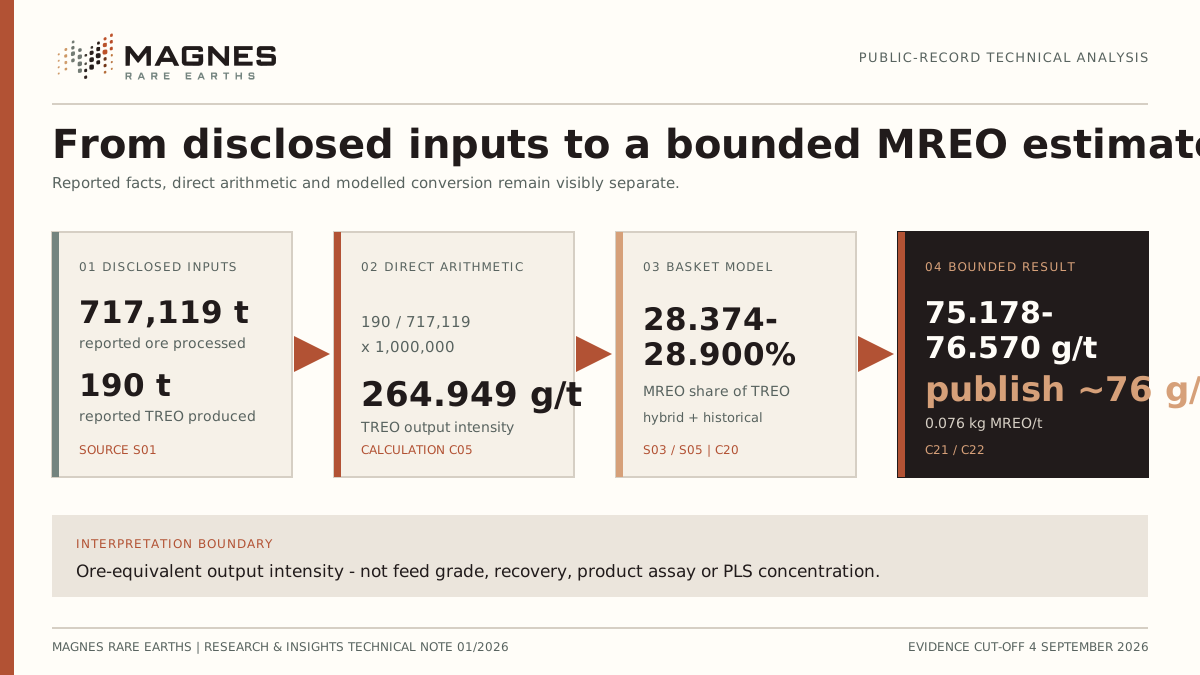
Serra Verde's public operating record supports one strong ore-to-output calculation. Across 2024 and 2025, SVRE reported 717,119 tonnes of ore processed and 190 tonnes of TREO produced. Dividing those disclosed figures gives 264.949 grams of TREO per reported tonne. [S01]
Applying a bounded magnetic-oxide share of 28.374342%-28.900% gives an estimated 75.178-76.570 g MREO/t. The responsible shorthand is therefore approximately 76 g MREO per reported tonne processed, equivalent to 0.076 kg/t. This is a Magnes calculation based on public inputs, not a figure disclosed by Serra Verde.
The approximately 76 g/t result is an output-intensity estimate: estimated Nd, Pr, Dy and Tb oxides in recorded TREO output divided by reported ore processed. It is not a measured head grade, formal metallurgical recovery, current MREC assay, leachable grade, in-situ grade or PLS concentration. The numerator includes TREO in bagged MREC and thickener work in progress; the denominator is ore measured at beneficiation entry, with no disclosed dry-tonne adjustment. [S01]
This third-party operating analysis is separate from Magnes exploration results. Its estimated output per tonne cannot be compared directly with Minas Americas head-grade assays, and it establishes no geological, metallurgical or economic comparability between the projects.
Core analytical conclusion
Estimated output intensity: approximately 0.076 kg MREO per reported tonne.
Always state the bridge: 264.949 g TREO/t multiplied by a 28.374%-28.900% magnetic-oxide share. Do not shorten the conclusion to "grade" or "recovery".
1. What the disclosed operating record supports
SVRE's KPI definitions make production, rather than sales, the appropriate numerator. "Ore processed" is measured at beneficiation entry and includes all ore fed regardless of ultimate recovery or product quality. "TREO produced" includes TREO in bagged mixed rare earth carbonate and TREO already produced in the thickener but not yet bagged. [S01]
Scroll the table horizontally to read all columns.
| Metric | 2024 | 2025 | Combined |
|---|---|---|---|
| Ore processed | 584,946 t | 132,173 t | 717,119 t |
| TREO produced | 150 t | 40 t | 190 t |
| TREO output intensity | 256.434 g/t | 302.634 g/t | 264.949 g/t |
| MREO proxy at historical 28.9% basket | 74.109 g/t | 87.461 g/t | 76.570 g/t |
Reported inputs: S01. Calculations: C01-C05, C14 and C22. Whole-tonne KPI rounding is retained; additional decimals are shown only for reproducibility.
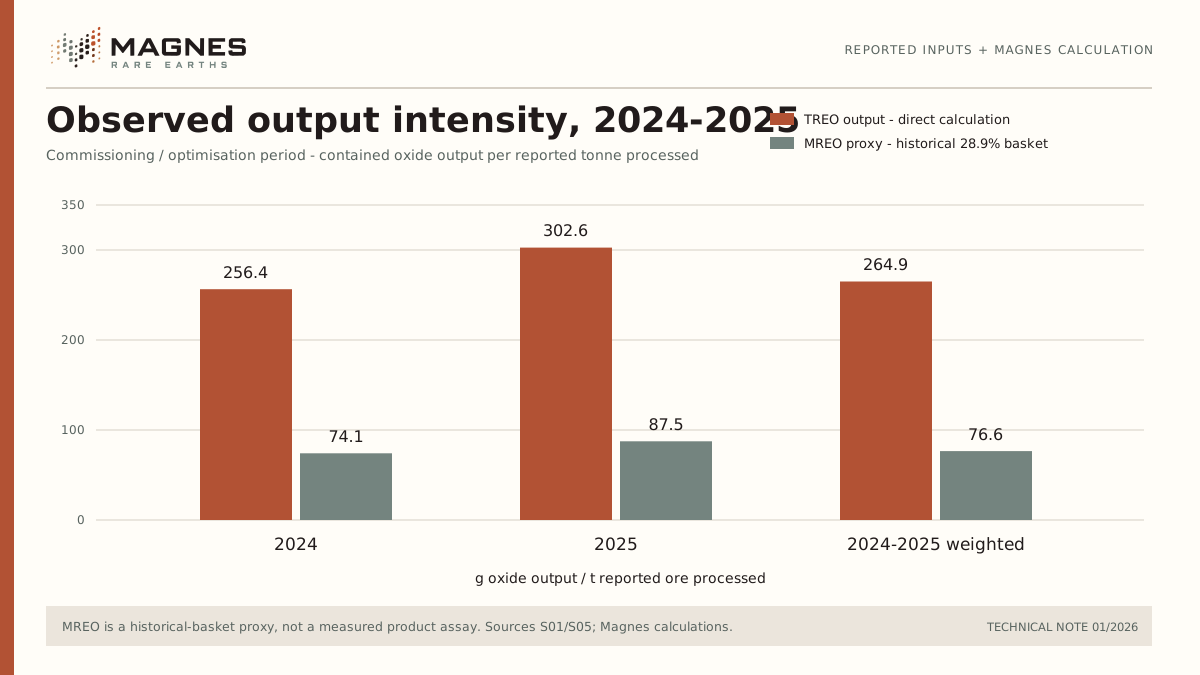
The direct 264.949 g TREO/t calculation is the strongest numerical conclusion because the numerator and denominator are both disclosed on the same KPI basis. Confidence in the MREO conversion is lower because the defined source corpus does not contain a current mass-basis product oxide distribution.
2. How the TREO result becomes a bounded MREO estimate
For this report, MREO means the combined oxide-equivalent mass of Nd, Pr, Dy and Tb. The upper conversion uses a historical August 2016 Serra Verde relative oxide basket: Nd 19.3%, Pr 5.9%, Dy 3.2% and Tb 0.5%, totalling 28.9% of TREO. [S05]
The preferred hybrid conversion keeps the historical Nd and Pr shares but replaces Dy and Tb with current-normalised quantities from the April 2026 forward-looking presentation. That produces a 28.374342% MREO/TREO share. [S03][S05]
Scroll the table horizontally to read all columns.
| Basket basis | MREO share of TREO | Combined output estimate | Status |
|---|---|---|---|
| Preferred hybrid | 28.374342% | 75.177551 g/t | Author inference; not product assay |
| Historical slide-18 basket | 28.900000% | 76.570276 g/t | Historical relative distribution; not current product assay |
| Published shorthand | Bounded by both | approximately 76 g/t | Rounded to avoid false precision |
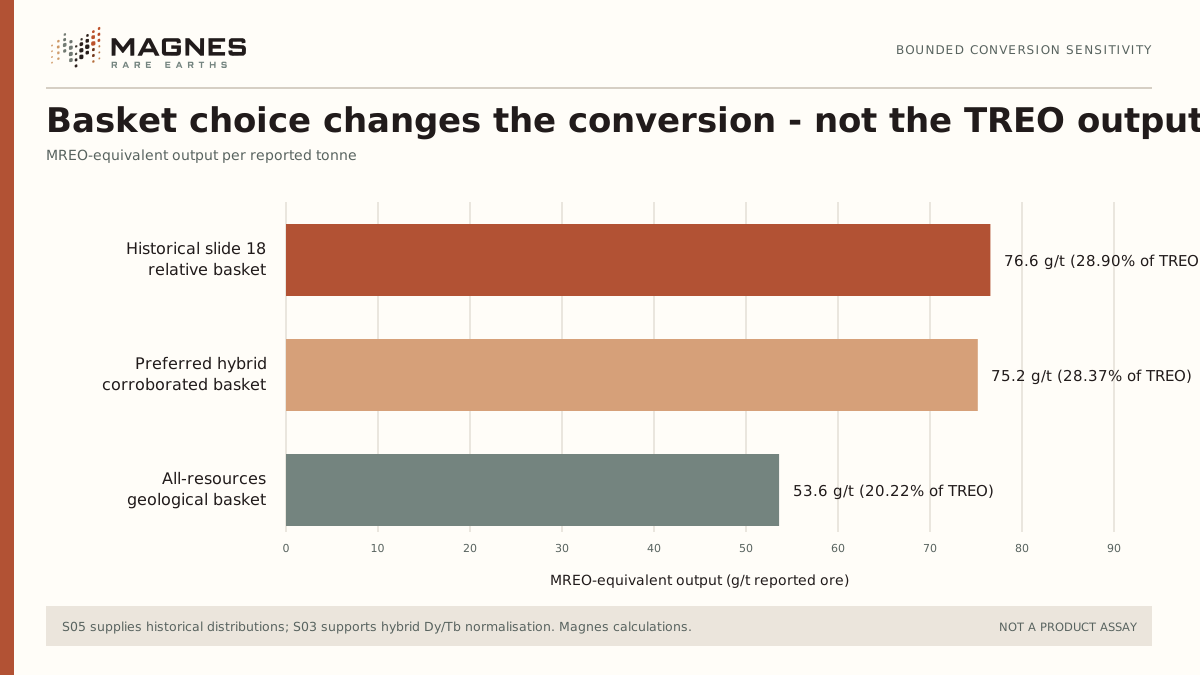
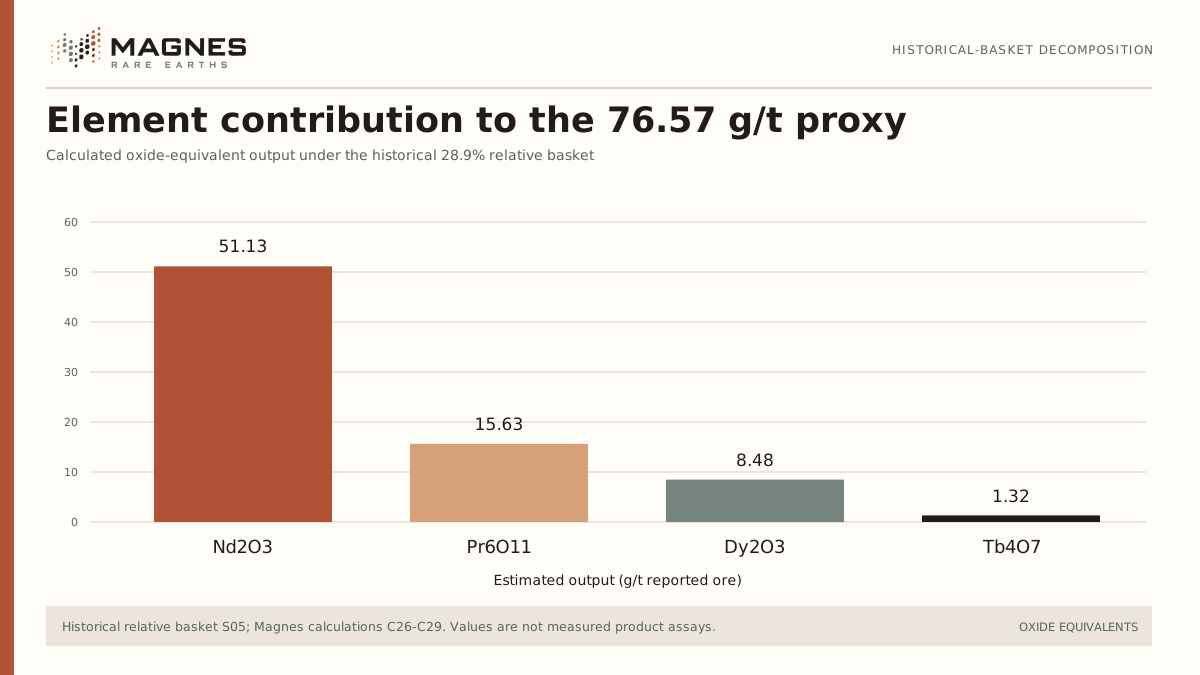
The 2016 table is read as a dated ore-normalised relative basket, not a physical MREC product assay. The April 2026 presentation's displayed "basket composition" percentages are explicitly value-weighted by forecast prices and are excluded from every mass-balance calculation. [S03][S05]
3. What the public record does not allow us to calculate
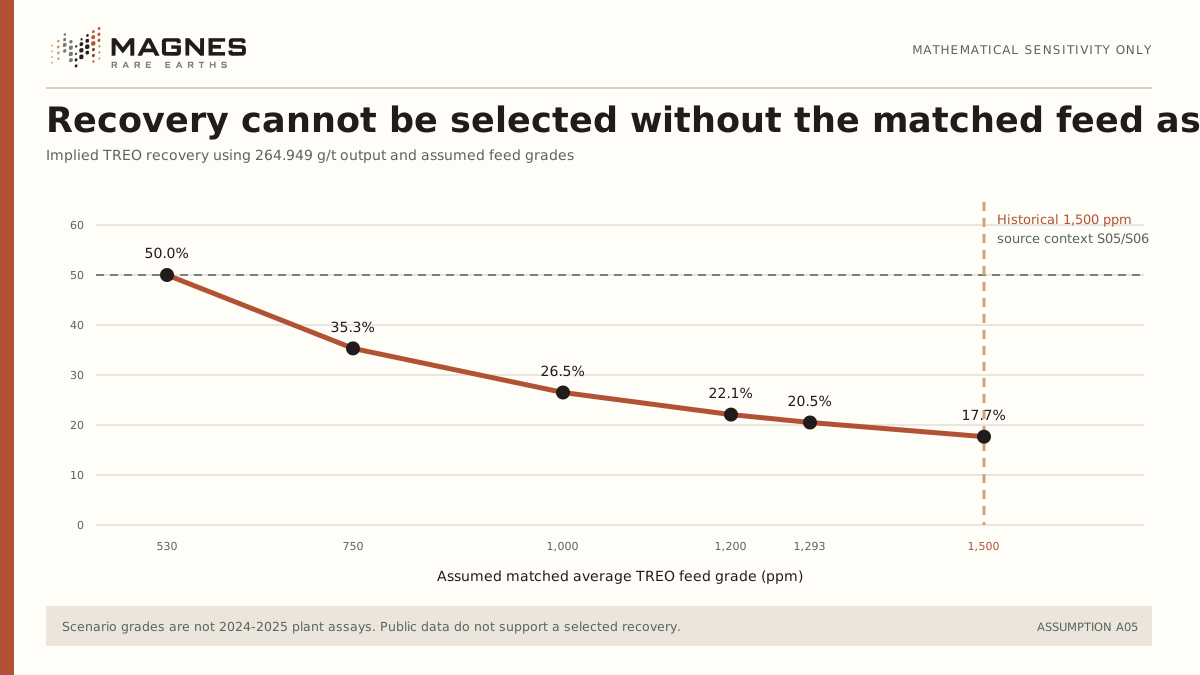
A formal recovery result asks what proportion of contained oxide in matched feed reaches product. That requires more than processed tonnes and produced tonnes:
Recovery (%) = contained oxide in matched product / contained oxide in matched dry feed x 100
Scroll the table horizontally to read all columns.
| Required field | Required basis | Why it matters |
|---|---|---|
| Dry ore feed | Tonnes, moisture and matched time window | Defines the denominator and removes wet-tonne ambiguity |
| Feed assays | TREO and Nd, Pr, Dy, Tb ppm | Defines contained feed oxide |
| Residue | Dry tonnes, moisture and oxide assays | Measures extraction losses |
| MREC / precipitate | Dry product tonnes, TREO% and oxide distribution | Measures contained product |
| Work in progress | Opening and closing thickener and bagged inventory | Matches ore feed to the output period |
| Solution balance | PLS, barren, recycle and wash volumes and assays | Supports an actual leachate concentration and solution recovery |
No complete matched set of these fields was identified in S01-S11 through 4 September 2026. That negative finding does not prove private or unpublished data do not exist.
Current PLS grade also remains unavailable
A pregnant-leach-solution grade needs recovered mass and a matched net solution volume, preferably with pregnant, barren, recycle and wash-stream assays. The current process disclosure confirms ion exchange but does not publish those measurements. Any mg/L result produced by assuming a solution volume would be a sensitivity only, not a Serra Verde assay. [S01]
4. Production, sales, inventory and residence-time risk
Sales are not matched to the ore-processing period. SVRE reported 150 t TREO produced and 11 t sold in 2024, followed by 40 t produced and 138 t sold in 2025. The 2025 sales figure therefore principally reflects monetisation of accumulated inventory rather than that year's production alone. [S01]
Scroll the table horizontally to read all columns.
| 2025 bridge | TREO | Treatment |
|---|---|---|
| Opening inventory at 31 December 2024 | 117 t | Reported |
| Plus 2025 production | 40 t | Reported |
| Less 2025 sales | (138 t) | Reported |
| Expected closing inventory before residual | 19 t | Calculated |
| Reported closing inventory at 31 December 2025 | 46 t | Reported |
| Unreconciled public-data residual | 27 t | Calculated |
The 27 t residual is not evidence of an accounting error. It shows that the public production, sales and closing-inventory figures do not expose every WIP category, timing, assay, loss, reclassification or measurement adjustment needed for a metallurgical bridge. [S01]
5. Historical evidence: useful, but not current performance
The March 2015 RIMA describes a historical heap-leach design: 32 days of irrigation and washing, eight days of drainage within a 60-day operating cycle, 10 kg/t sodium chloride, approximately 0.5 kg/t sulphuric acid, 0.68 kg/t carboxymethylcellulose and approximately one-half rare-earth extraction. [S06][S11]
The 2026 disclosure describes the operating plant in a different five-step sequence: screening; ion exchange; press filters and precipitation; thickening; and concentrate press filters. The historical cycle, reagent consumption and extraction statement must therefore not be represented as current plant configuration or performance. [S01][S06]
Historical resource and particle-size context
The latest detailed resource and reserve table in the defined corpus is historical. The August 2016 presentation attributes it to RPA, dated February 2015, applying CIM definitions and drilling through 27 November 2014: 390 Mt measured and indicated at a rounded 0.15% TREO, 521 Mt inferred at 0.10% TREO, and a 350 Mt proven and probable reserve at 0.15% TREO. These figures are reproduced only as historical context. They are not a current resource or reserve statement and should not be represented as S-K 1300 or NI 43-101 disclosure. [S05]
The same presentation reports one historical sample, MET001, at 2,872 ppm calculated TREO on a natural-humidity basis. Its minus-38 micrometre fraction represented 22.7% of mass and 54.03% of TREO distribution. That observation shows why particle-size routing can affect the stream entering extraction; it does not establish average 2024-2025 feed grade. [S05]
6. Forward-looking Phase I scenarios
Current public materials project approximately 6,400 tpa gross TREO after ramp-up. The offtake term ends at the earlier of products derived from 198 Mt ROM or 20 years after commercial operations commence. A steady-state annual ROM throughput denominator is not directly disclosed. [S01][S04][S09]
Dividing 198 Mt by 20 years produces an illustrative 9.9 Mtpa co-termination scenario, not guidance. Combining that assumed denominator with 6,400 tpa gives 646.465 g gross TREO/t ROM and 183.430-186.828 g MREO/t ROM under the two basket models.
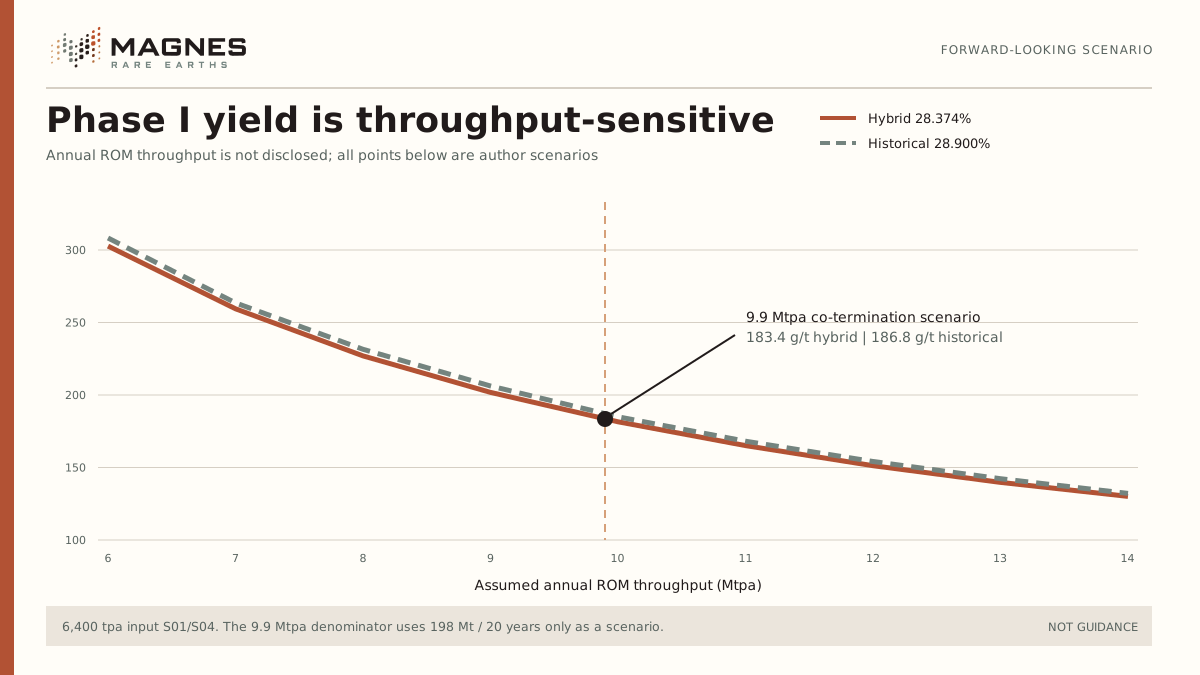
These calculations are sensitivities, not Magnes or Serra Verde guidance, forecasts, targets or valuations. Forward-looking statements reproduced from third-party sources remain subject to the qualifications, assumptions and risks in those original documents. Magnes does not adopt them as its own guidance.
Latest disclosures checked
On 24 August 2026, Serra Verde stated that the first optimisation stage was in advanced commissioning, with an approximately 4,000 tpa TREO run-rate expected by end-2026, and that a second stage was under construction with commissioning expected to begin within 12 months. The release repeated the longer-term approximately 6,400 tpa expectation. [S09]
On 31 August 2026, USA Rare Earth filed the result of the 28 August special meeting, reporting approval of the share-issuance proposal. That filing is transaction context only. Neither update supplies current feed, product, residue or PLS measurements, so the core demonstrated-period conclusion is unchanged. [S09][S10]
7. How to use the result responsibly
- Say: approximately 76 g MREO in recorded output per reported tonne processed across 2024-2025.
- Show: 264.949 g TREO/t multiplied by the bounded 28.374%-28.900% MREO share.
- Label: public-record reconstruction, author calculation and ore-equivalent output intensity.
- Do not call it: feed grade, recovery, current product assay, leachable grade, in-situ grade or PLS concentration.
- Keep separate: historical evidence, current reported operations and forward-looking scenarios.
- Verify: read the original source documents in full before relying on any third-party statement.
Assumption register A01-A07
- A01 · Hybrid basket
- Retains the historical slide-18 Nd and Pr mass shares and substitutes current-normalised Dy and Tb shares derived from forward-looking presentation quantities. It is not a product assay.
- A02 · Offtake-limit co-termination
- Divides 198 Mt by 20 years only as a scenario in which both contractual termination limits bind at the same time. The contract says earlier of; it does not disclose annual ROM throughput.
- A03 · PLS scenario volumes
- Assumes the full 76.570276 g/t historical-basket MREO proxy appears in the stated net solution volume. Recycle, washes, WIP and precipitation losses are ignored.
- A04 · 1,200 ppm sensitivity
- Uses 1,200 ppm only as an author sensitivity 20% below the historical 1,500 ppm source point. It is not a separate disclosed Serra Verde feed grade.
- A05 · Recovery sensitivity grades
- Treats the feed grades in the recovery curve as hypothetical except for the historical 1,500 ppm context. They are not 2024-2025 plant assays.
- A06 · Simple two-year inventory bridge
- Assumes zero opening inventory at 1 January 2024 only to show why the two-year figures are not a closed balance. The actual opening balance is not disclosed in the KPI discussion.
- A07 · Downstream separation overlay
- Applies the presentation's 95% MREC-to-separated-oxide assumption mechanically to the co-termination scenario. It is not measured Pela Ema plant recovery.
Non-disclosure audit ND01-ND07
- ND01 · Matched current feed grade
- No monthly, quarterly or campaign-level average dry-feed TREO or MREO assay matched to the 2024-2025 output period was identified.
- ND02 · Current product oxide distribution
- No current MREC mass-basis Nd, Pr, Dy and Tb distribution matched to 2024-2025 production was identified.
- ND03 · Current PLS grade
- No current PLS volume per tonne, PLS Nd/Pr/Dy/Tb assays or matched pregnant/barren/recycle solution balance was identified.
- ND04 · Current residue/extraction balance
- No matched dry residue tonnes, residue assays or element-specific extraction balance was identified.
- ND05 · Closed production/inventory bridge
- The disclosed production, sales and year-end inventory numbers do not include enough category or WIP detail for a closed metallurgical reconciliation.
- ND06 · Dry-tonne basis
- The ore-processed definition states weight at beneficiation entry, but the reviewed disclosure does not state a dry-tonne moisture adjustment.
- ND07 · Steady-state annual ROM throughput
- Current disclosures give projected annual TREO output and offtake limits, but no directly disclosed steady-state ROM tonnes-per-year denominator.
Frequently asked questions
What is the report's main conclusion?
The disclosed 2024-2025 operating data support a direct result of 264.949 g TREO per reported tonne processed. Applying the report's bounded magnetic-oxide basket gives 75.178-76.570 g MREO/t, responsibly rounded to approximately 76 g/t or 0.076 kg/t.
Is approximately 76 g/t the Serra Verde feed grade?
No. It is an ore-equivalent output-intensity estimate: recorded MREO-equivalent output divided by reported ore processed. It is not a measured head grade, leachable grade or in-situ grade.
Does the estimate establish metallurgical recovery?
No. A recovery calculation needs matched dry-feed tonnes and assays, product and residue assays, and an inventory/WIP bridge over the same period. Those fields were not identified in the defined public corpus.
Can current pregnant-leach-solution grade be calculated?
No. Current PLS volume and element assays, together with pregnant, barren, recycle and wash-stream balances, were not identified. Any mg/L figure without those measurements would be a mathematical scenario rather than a plant assay.
Why does the report use a range for MREO share?
The low end uses a hybrid 28.374342% share combining historical Nd/Pr mass shares with current-normalised Dy/Tb quantities. The high end uses the 28.9% historical relative basket. Neither is a current product assay.
Is this a current mineral resource or reserve statement?
No. Any resource, reserve, grade or metallurgy figures discussed from the 2015-2016 materials are historical third-party context only. This article is not an S-K 1300 or NI 43-101 technical report and has not been verified by a Magnes qualified person for that purpose.
Magnes investor updates
Stay informed about Magnes
Receive public company announcements, technical updates and new presentations by email.
Confirm your email to subscribe. Unsubscribe at any time.
Get investor updates
Methodology and source register
This is a desktop review of public filings, issuer releases, DFC-hosted environmental documents and a historical project presentation. Magnes did not conduct a site visit, audit operating records, sample material, verify assays or prepare a mineral resource or reserve estimate for this analysis. Reported facts, Magnes calculations, assumptions and non-disclosure findings are deliberately separated.
The technical note is dated 4 September 2026. This web edition carries the planned first-online-publication date of 8 September 2026. The evidence cut-off remains 4 September 2026.
SVRE Holdings Ltd. - Supplemental Disclosures / MD&A, Exhibit 99.2
- Location
- Business and process pp. 1-4; MD&A pp. 8-13; KPI table and definitions pp. 11-13
- Used for
- Current process, 2024-2025 KPIs, KPI definitions, inventory, operating status and offtake limits
USA Rare Earth - Definitive Proxy Statement for Serra Verde share issuance
- Location
- SVRE business, financial and transaction sections
- Used for
- Corroborating integrated transaction disclosure; not required for the core arithmetic
USA Rare Earth + Serra Verde - Acquisition Investor Presentation, Exhibit 99.3
- Location
- Slides 4-6, especially slide 5 notes
- Used for
- Forward-looking 6,400 tpa; 95% downstream assumption; projected Dy, Tb and Y quantities; value-basket warning
USA Rare Earth - Definitive agreement acquisition release, Exhibit 99.1
- Location
- Phase I production and EBITDA footnotes
- Used for
- 6,400 tpa gross TREO and approximately 4,400 tpa after lanthanum removal
Serra Verde Rare Earth Project - Geology
- Location
- PDF pages 6-7, 11-12, 16 and 19 (slides 5-6, 10-11, 15 and 18)
- Used for
- Historical process, grain-size sample, RPA resource/reserve tables and relative oxide distributions
Serra Verde - Relatorio de Impacto Ambiental (RIMA), Volume I
- Location
- PDF page 19 for cycle/reagents; PDF page 51 for the approximately one-half extraction statement
- Used for
- Historical heap-leach design, reagent consumption and extraction benchmark
DFC - Initial Project Summary, Serra Verde Rare Earths Project
- Location
- PDF page 1
- Used for
- Existing project description; DFC proceeds for debottlenecking and extraction-process optimisation
Serra Verde Group - Serra Verde Enters Commercial Production
- Location
- Release body
- Used for
- Commercial-production announcement and then-expected production after ramp-up
Serra Verde - Offtake SPV capitalisation and operational update, Exhibit 99.2
- Location
- Opening operational update and About section
- Used for
- Advanced commissioning; approximately 4,000 tpa run-rate expected by end-2026; 6,400 tpa long-term expectation
USA Rare Earth - Form 8-K reporting special-meeting vote
- Location
- Item 5.07
- Used for
- Stockholder approval of the share issuance; transaction-status context only
DFC - Serra Verde environmental and social disclosure index
- Location
- Document index
- Used for
- Provenance and public validation path for the RIMA and project summary
This Magnes-authored analysis is based solely on the public source corpus listed above and Magnes calculations and scenarios identified as such. It is not independent third-party research on Magnes. Serra Verde, Pela Ema, SVRE Holdings Ltd., USA Rare Earth, the U.S. Securities and Exchange Commission, the U.S. International Development Finance Corporation and all other cited parties did not prepare, review, approve, sponsor or endorse this article. All third-party names and marks belong to their respective owners. No affiliation is implied.
Magnes has sought to reproduce the cited public information accurately but makes no representation or warranty, express or implied, as to the accuracy, completeness or continuing currency of third-party information. Public disclosures can be incomplete, amended or superseded. Readers should review the original documents, their full qualifications and subsequent filings before making any decision or repeating any figure.
This article is not a technical report under NI 43-101 or S-K 1300, is not a mineral resource or mineral reserve statement, and is not a qualified-person opinion, feasibility study, valuation, fairness opinion or assurance engagement. Historical resource, reserve, grade, process and metallurgy information is clearly identified and has not been independently verified by Magnes for current-reporting purposes.
Nothing here is investment, legal, tax, accounting, engineering or other professional advice; an offer, solicitation or recommendation to buy or sell any security; or a forecast of production, recovery, revenue, price or value. The analysis makes no statement about the geology, metallurgy, resources, reserves, economics or expected performance of Magnes's Minas Americas project. To the extent permitted by law, no reliance should be placed on this article as a substitute for original disclosures or independent professional advice.