

A refinery cannot separate terbium that is absent from its feed. That simple constraint is easy to overlook in a market where seventeen different elements are routinely discussed as one commodity.
China combines a substantial mineral endowment with extensive processing and manufacturing. But those strengths do not establish equal self-sufficiency in every element. China’s own Geological Survey describes abundant light-rare-earth resources alongside relatively scarce medium and heavy resources. [2]
For dysprosium (Dy) and terbium (Tb), the important distinction is between securing feedstock and controlling its conversion into useful products. Understanding that distinction changes both the supply-security argument and the commercial case for a new mine.
China’s processing position does not establish domestic self-sufficiency. Its use of foreign feedstock does not, by itself, establish a current shortage for Chinese final users.
One label, very different resources
The IEA’s 2026 review reports approximately 44 million tonnes of Chinese rare-earth reserves on a rare-earth-oxide-equivalent basis. Reserves are economically contingent and can change with exploration, prices and technology. The aggregate is neither an interchangeable stock of magnet ingredients nor a production schedule. [1]
China’s major light-rare-earth deposits, including Bayan Obo and Maoniuping, underpin its substantial position in lanthanum (La), cerium (Ce), neodymium (Nd) and praseodymium (Pr). The Geological Survey explicitly distinguishes this endowment from the less abundant medium/heavy resources. [2]
An orebody’s total rare-earth content cannot answer how much Dy or Tb a plant can deliver annually. That requires elemental composition, recoverable fractions, throughput, processing performance and operating permissions. More output of one co-produced element does not necessarily resolve a shortage of another.
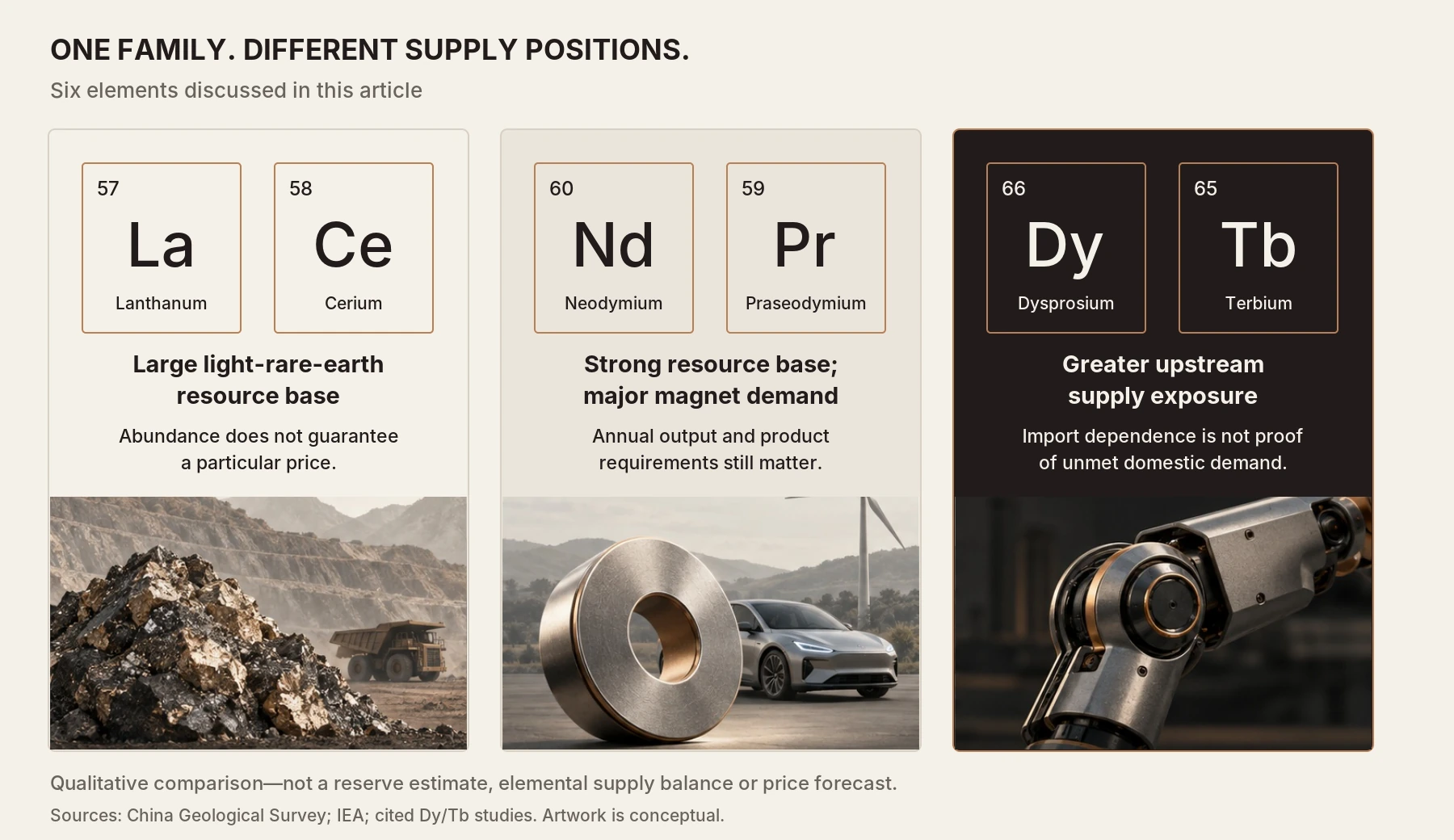
Read Figure 1 as text and data
Scroll the table horizontally to read all columns.
| Elements | Qualitative description | Limit |
|---|---|---|
| La and Ce | Large light-rare-earth resource base | Abundance does not guarantee a particular price. |
| Nd and Pr | Strong resource base; major magnet demand | Annual output and product requirements still matter. |
| Dy and Tb | Greater upstream supply exposure | Import use does not prove unmet domestic demand. |
Qualitative comparison, not a national supply-coverage estimate or price forecast. Sources [1,2,6,8].
This comparison is deliberately limited. Samarium, yttrium, scandium and the other rare earths have distinct markets and production routes; they cannot simply be assigned to an “abundant remainder”. Nor does the evidence establish that Tb is categorically more vulnerable than Dy in every application or period.
The supplier also has suppliers
The IEA estimates China’s 2024 shares at 60% of magnet-rare-earth mining, 91% of refining and 94% of sintered permanent-magnet production. Mining and refining here cover Nd, Pr, Dy and Tb; the final percentage describes magnet production, not a share of mined atoms. Different stage-specific denominators prevent subtraction into an import-dependence ratio. [1]
The same report estimates that Myanmar supplied more than 40% of global mined Dy and Tb combined in 2024 and describes feedstock moving into China. The IEA also notes informal production and underreporting. This is a combined historical estimate—not a separate import percentage for either element or an observed 2026 deficit. [1]
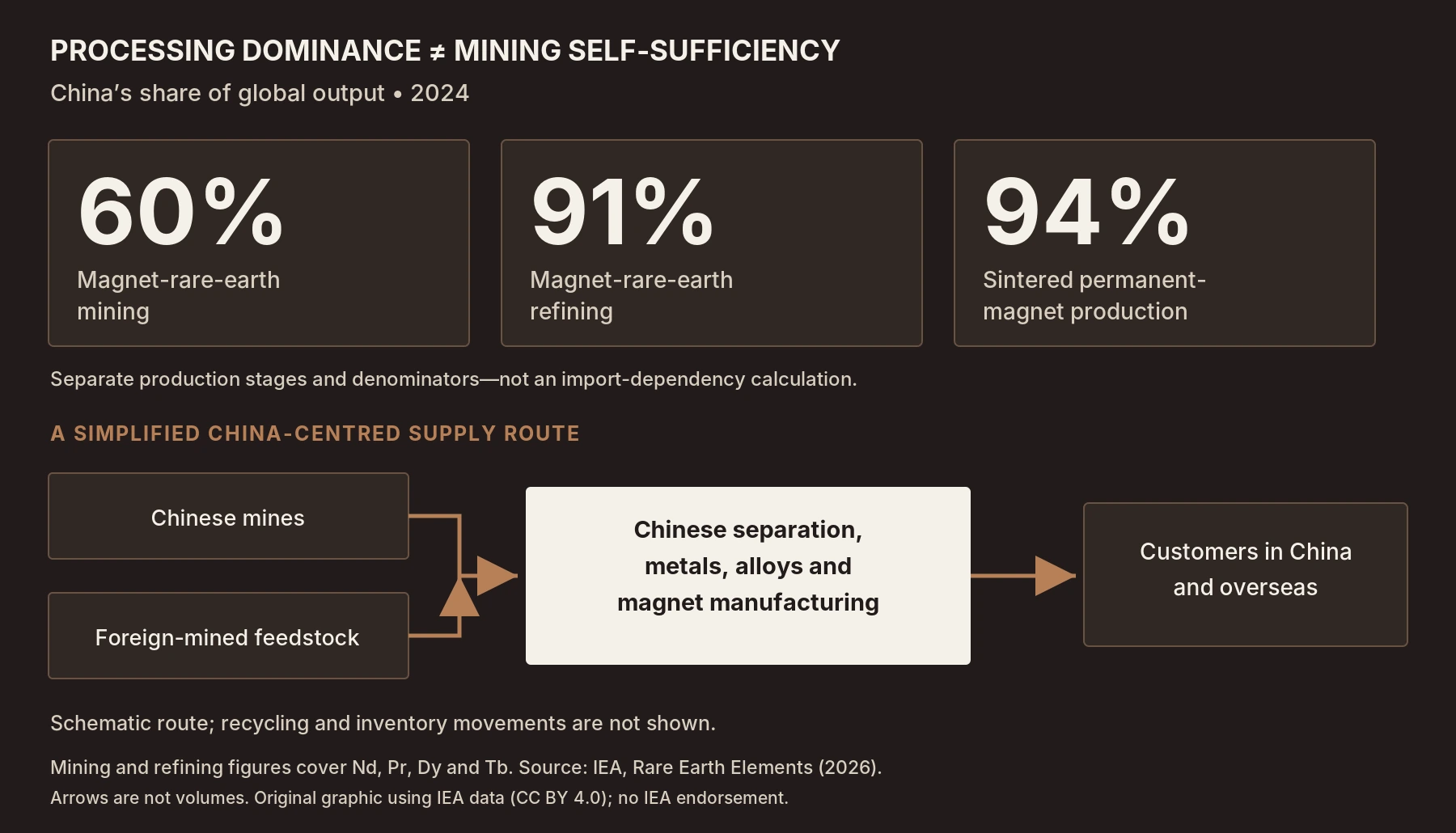
Read Figure 2 as text and data
Scroll the table horizontally to read all columns.
| Stage | China share | Scope and year |
|---|---|---|
| Mining | 60% | Magnet rare earths (Nd, Pr, Dy, Tb); 2024 |
| Refining | 91% | Magnet rare earths (Nd, Pr, Dy, Tb); 2024 |
| Magnet production | 94% | Sintered permanent-magnet production; 2024 |
Separate denominators: do not subtract these values to obtain an import share. Historical IEA estimates [1].
Imports can be commercially preferred, operationally necessary over a short adjustment period, or useful as supply insurance. A purchase alone does not distinguish these explanations. The IEA describes aggregate rare-earth markets as well supplied over the preceding decade; that does not establish adequacy for every element or customer. Nor can an unmeasured domestic response be assumed to replace imports immediately. [1]
Three questions—not one
Scroll the table horizontally to read all columns.
| Question | What the evidence establishes |
|---|---|
| Do Chinese mines provide all the feedstock used by China-based manufacturing, including exports? | No. Foreign-mined material enters the system. This establishes use of imports, not the minimum unavoidable import requirement. [1] |
| Could Chinese mines alone cover Chinese domestic final consumption? | Not resolved by the reviewed national data. This requires separating domestic final use from export-related manufacturing, element by element. |
| Is all available supply insufficient for Chinese domestic final users? | A current national shortfall is not demonstrated here. Imports, recycling, usable stocks and allocation must all be included before making that claim. |
A Chinese-made magnet exported inside a motor serves overseas demand. Its manufacture nevertheless consumes feedstock in China. Curtailing that export could change material availability, but the amount depends on the element and product mix. A factory’s location is not the location of final consumption.
“China imports Dy/Tb”, “Chinese mines cannot cover domestic final use” and “Chinese customers cannot obtain enough material” are therefore different propositions. The first does not prove the other two. A future supply model must also specify how much time, investment and redesign it allows.
Dy and Tb: small additions, consequential performance
In neodymium–iron–boron (NdFeB) magnets, Dy and Tb can increase intrinsic coercivity: resistance to demagnetisation under an opposing magnetic field. This helps particular formulations retain performance under demanding thermal conditions. It is not simply an increase in magnetic “strength” or a statement about the Curie temperature. [3]
Heavy-rare-earth additions can trade off against remanence (Br), the residual magnetic flux density at zero magnetic field after magnetisation. Grain-boundary diffusion can improve that trade-off by concentrating additions near the surfaces of magnetic grains. Shin-Etsu describes improved coercivity with less Dy/Tb and a smaller loss of remanence than conventional bulk addition. [3]
Results remain grade- and geometry-dependent. Shin-Etsu’s specifications expressly qualify grain-boundary-diffused properties by magnet size and shape. A component designer must establish the required temperature, load, magnetic performance and qualification; an elemental recipe alone is not a performance guarantee. [4]
Robotics is an additional demand question—not a fixed tonnage
The IEA expects EVs and wind to contribute to magnet-rare-earth growth through 2030, with automation, robotics and digital technologies increasingly important thereafter. That outlook concerns Nd, Pr, Dy and Tb collectively. It does not establish humanoid robots as the main growth driver of either Dy or Tb. [1]
For a robot, counting joints does not determine rare-earth demand. The calculation needs annual unit volumes, motor architecture, magnet mass and elemental composition; operating temperature and performance requirements affect the chosen grade. Some actuators may need Dy/Tb additions; others may not. Demand included under industrial motors or automation must not be counted again as a separate “robotics revolution”.
Nor are Dy and Tb universally irreplaceable. Honda and Daido’s 2016 hybrid-motor announcement used a hot-deformed, heavy-rare-earth-free magnet and a redesigned motor. It was a specific commercial design—not proof that every existing motor can switch unchanged. TDK likewise describes reduced-heavy-rare-earth magnet solutions. [5,16]
Strategic importance is not universal indispensability. What matters during a disruption is how much demand can adapt, at acceptable performance and cost, before supply runs short.
China’s own dysprosium research: read the denominator
A 2023 study by Dai and co-authors modelled dysprosium use in China under three climate scenarios. Its stock-based treatment of vehicles, appliances and wind makes it relevant to domestic development requirements—not just export manufacturing. The institutional summary is an account of the same study, not independent corroboration. [6,7]
In the study’s quota-constrained case, Chinese domestic primary supply reaches 2.7 thousand tonnes of elemental Dy per year in 2050. Baseline annual demand is 13.1, 19.0 or 25.3 thousand tonnes. Their ratios are approximately 21%, 14% and 11%. These reproduce the paper’s reported input comparison—not current observations or a new yield-adjusted national material balance. [6]
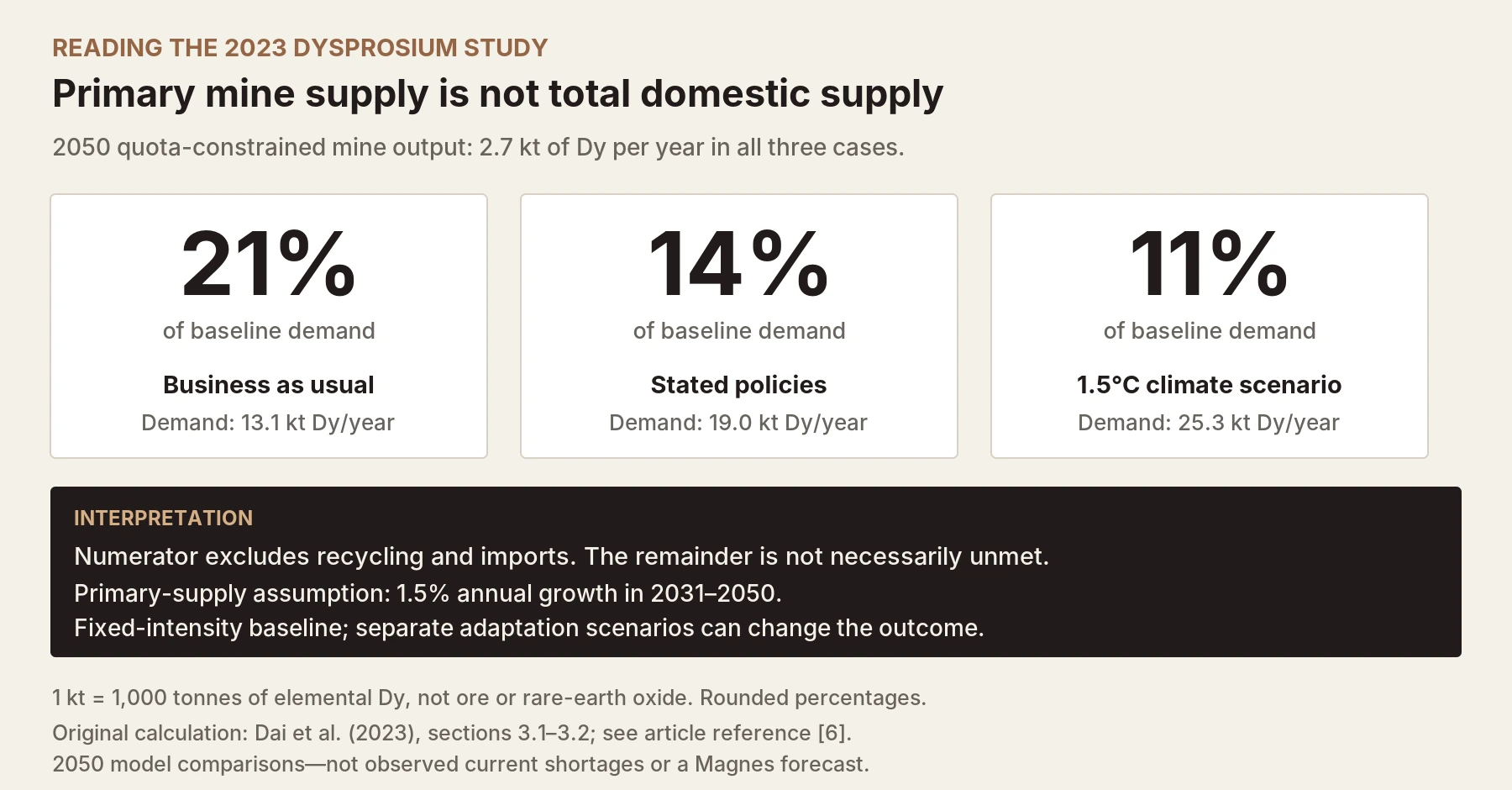
Read Figure 3 as text and data
Scroll the table horizontally to read all columns.
| 2023 study scenario | 2050 primary supply (kt Dy/year) | 2050 baseline demand (kt Dy/year) | Calculated ratio |
|---|---|---|---|
| Business as usual | 2.7 | 13.1 | 21% |
| Stated policies | 2.7 | 19.0 | 14% |
| 1.5°C climate scenario | 2.7 | 25.3 | 11% |
1 kt is 1,000 tonnes of elemental dysprosium. The numerator excludes imports and recycling. The baseline holds application-specific material intensity fixed; separate adaptation scenarios change the outcome. The remainder is not necessarily unmet demand. Source [6].
The assumptions matter: quota-constrained primary supply grows 1.5% annually from 2031 to 2050. The baseline uses fixed application-specific Dy intensity; separate adaptation cases change it. These are the 2023 study’s scenarios, not the IEA’s 2026 forecast or an official production commitment. Recycling is separate, and several adaptation combinations eventually balance the model. [6]
The study illustrates a conditional requirement for other supply or demand responses. It is not a present shortage measurement, a technical ceiling on Chinese mine output or an exhaustion date. In particular, the difference from 100% in Figure 3 is neither an unavoidable import share nor a quantity necessarily left unsupplied. The authors identify substantial data uncertainty. [6]
Terbium: a statistical gap is not an unfilled order
A related study reconstructed Tb flows through 2018. Its difference between estimated demand and formally recorded supply includes unregistered production and statistical discrepancies. Its inferred Tb quota is calculated from rare-earth quotas and assumed elemental content; it is not a directly published official Tb production quota. [8]
That research supports concern about supply visibility and reliability. It does not demonstrate that Chinese domestic customers currently lack terbium. Its historical coverage and use of demand information from other markets limit that inference. Dy and Tb also have different distributions and uses: neither a combined mining statistic nor a Dy-only scenario establishes Tb’s balance. [8]
Export permission and physical availability are separate constraints
China’s April 2025 announcement introduced licensing for specified rare-earth-related items, including defined Dy/Tb materials and magnets. It is not a numerical export quota or a blanket prohibition on every rare-earth-containing product. A November 2025 decision suspends specified later measures until 10 November 2026; it does not repeal the April instrument. This distinction is not a complete account of every destination-, end-user- or technology-specific control. [9,17]
Export administration has also featured in negotiations. In June 2025, China’s Ministry of Commerce linked approval of qualifying controlled-item applications with corresponding US removal of restrictions. That official statement documents a negotiated arrangement; it does not reveal the physical balance of each element or establish the sole motive for the controls. [10]
Restricting permission can reduce foreign access even when material exists. A feedstock interruption can reduce production even when export permission exists. Both can affect customers, but evidence of one is not proof of the other. Supply insecurity and control over access can coexist; neither unlimited abundance nor forced rationing follows from the existence of a licence requirement.
Shenghe demonstrates a strategy—not an elemental balance
China’s 2016–2020 industry plan encouraged overseas resource and downstream-processing cooperation. Shenghe’s current business descriptions illustrate distinct routes: light-rare-earth activities in Sichuan, ionic and medium/heavy processing in Jiangxi, and international resource relationships. These are different feedstock and product businesses, not interchangeable sources of Dy/Tb. [11,12]
Commercial access can also change. MP Materials’ filing for the quarter ended June 2026 confirms that sales to Chinese customers ceased in July 2025 and the Shenghe offtake expired without renewal in January 2026. A historical investment or project list is therefore not proof of a continuing physical supply route. [13]
The useful question is what a particular asset can deliver, to which processor, under which rights and on what timetable. Overseas expansion can support manufacturing growth, diversification or resource security without proving that every acquisition responds to imminent geological depletion.
Supply can respond—but the timetable and units matter
China’s Geological Survey announced a large potential ion-adsorption resource in Honghe in 2025. That is evidence of additional geological potential, not annual recoverable Dy/Tb output or an operating timetable. [2]
Similarly, a June 2025 Hunan approval covers upgrades to existing 850- and 300-tonne-REO-per-year lines and expressly retains their capacity. It is not another 1,150 tonnes of capacity, still less 1,150 tonnes of Dy/Tb. Better performance could raise actual output within a permitted capacity, but the approval does not measure that result. [14]
A 2025 electrokinetic extraction study reported approximately 95% rare-earth recovery in a demonstration involving 5,000 tonnes of ore, with reduced ammonia emissions against its comparator. That is a process result at the examined site—not annual rare-earth production, a Dy/Tb-specific recovery guarantee, or a national environmental-performance result. [15]
Scroll the table horizontally to read all columns.
| Horizon from September 2026 | What could change the balance |
|---|---|
| Short term: 0–2 years | Available feed, usable inventories, operating recoveries and approved product formulations. An eventual substitute does not necessarily solve an immediate shortage. |
| Medium term: 3–5 years | Compliant upgrades, new feedstock routes and redesign. Announced capacity counts only when it produces accepted material; shared technical dependencies can delay several projects together. |
| Long term: 6–10 years | Discoveries, processing, end-of-life recovery and changing material intensity. Neither a fixed exhaustion date nor unlimited supply is established. |
Recycling is also time-dependent. Manufacturing scrap already circulating through production cannot be counted repeatedly as new supply. End-of-life material becomes available only as products retire and are collected, separated and recovered. Stocks and flows must be kept separate; a large installed stock is not material a factory can use today. [6]
What the next supplier must deliver
For an ionic-clay developer, the starting point is not simply “heavy rare earths in clay”. Mineralogical research distinguishes readily exchangeable, adsorbed rare earths from less accessible mineral-bound material. Clay-hosted mineralisation therefore needs tests of each element’s recoverability, not an assumed recovery derived from the deposit label. [18]
The development case must link representative assays to a repeatable flowsheet, impurities, residues, reagent requirements, permissions and an accepted saleable product. A high total heavy-rare-earth percentage—especially where yttrium contributes strongly—does not by itself establish valuable recoverable Dy/Tb output.
Commercial value then depends on what the buyer pays for, processing and logistics deductions, financing, delivery timing and credible alternatives. Scarcity in one element does not guarantee a profitable mixed product. A project should remain credible when prices fall, customers redesign equipment or competing sources arrive.
Neither “China can flood every market indefinitely” nor “China has run out” follows from the evidence. Chinese processing uses foreign-mined material, including heavy-rare-earth feedstock, but the reviewed data do not settle domestic-mine-only sufficiency or establish a current national shortage after imports, recycling and usable stocks. Upstream exposure also does not make Dy/Tb prices immune to new supply, lower material intensity or weaker demand. [1,6,8]
The next meaningful tonne is the right element, in an accepted product, delivered when a customer needs it—not simply the next tonne discovered.
Evidence and disclosure
Evidence reviewed to 21 September 2026. Historical estimates retain their observation years; the 2024 production shares are not measurements of September 2026 market shares. This is public-source sector analysis, not a reconciled Chinese elemental balance or a re-estimation of the cited academic models. Future pathways are conditional. Artwork is AI-generated and conceptual; numerical graphics use identified data and reproduced arithmetic.
Magnes Rare Earths has a commercial interest in rare-earth development. This article is not investment advice, project production guidance, or a declaration of mineral resources, reserves, recoveries, economics or customer commitments. Third-party studies do not validate a Magnes project. This editorial review is not an independent engineering or Qualified Person sign-off.
Magnes investor updates
Stay informed about Magnes
Receive public company announcements, technical updates and new presentations by email.
Confirm your email to subscribe. Unsubscribe at any time.
Get investor updates
Sources
International Energy Agency. Rare Earth Elements: Pathways to Secure and Diversified Supply Chains. 2026; PDF revised May 2026. Executive summary; PDF printed pp. 18 and 30–31; demand discussion. 2024 stage-specific estimates, not current shares. Myanmar is Dy/Tb combined and underreported. IEA CC BY 4.0; this adaptation does not imply IEA endorsement.
Additional source: IEA report PDF · CC BY 4.0 licence
Back to textChina Geological Survey. Major rare-earth discovery in Yunnan (我国在云南新发现超大规模稀土矿). 17 January 2025. Official Chinese-language announcement. Distinguishes light-REE abundance from relative medium/heavy scarcity; reports potential resources, not a production schedule.
Back to textShin-Etsu Chemical. The alloying process by grain boundary diffusion. 28 March 2007; current technical-site version. Process description and coercivity/remanence comparison. Specialist manufacturer evidence on Dy/Tb use. Does not measure national adoption or future demand.
Back to textShin-Etsu Chemical. N Series Lineup. Accessed 21 September 2026. Magnetic-property tables and grain-boundary-diffusion qualification note. Properties depend on grade and, for the stated process, magnet size and shape.
Back to textHonda and Daido Steel. Daido Steel and Honda Adopt World’s First Hybrid Vehicle Motor Magnet Free of Heavy Rare Earth Elements. 12 July 2016. Hot-deformed magnet and redesigned hybrid drive motor. A specific commercial example. Heavy-rare-earth-free does not mean rare-earth-free or a universal drop-in substitute.
Back to textDai, T.; Liu, Y.-F.; Wang, P.; and co-authors. Unlocking Dysprosium Constraints for China’s 1.5 °C Climate Target. Online 14 September 2023. Environmental Science & Technology 57(38), 14113–14126; sections 2.1–2.3, 3.1–3.5. Figure 3 uses reported 2050 primary supply of 2.7 kt Dy/year and demands of 13.1, 19.0 and 25.3 kt. Section 2.3.3 defines total domestic supply as primary quota supply plus secondary supply. Not a 2026 forecast.
Back to textInstitute of Urban Environment, Chinese Academy of Sciences. Research progress on dysprosium circulation under carbon neutrality. 30 October 2023. Institutional summary of reference 6. Its reported 36–44% domestic supply coverage must not be described as mine-only coverage. This summary is not independent corroboration; the numerical graphic instead uses directly reported primary-study inputs.
Back to textChen, W.; Wang, P.; Meng, F.; and co-authors. Reshaping heavy rare earth supply chains amidst China’s stringent environmental regulations. Online 26 January 2024; issue March 2025. Fundamental Research 5(2), 505–513; sections 2–4. DOI: 10.1016/j.fmre.2023.11.019. Historical reconstruction through 2018. Tb quota is inferred; formal-supply gaps include unregistered material and statistical discrepancies, not measured current unmet final demand.
Back to textMinistry of Commerce and General Administration of Customs, China. Announcement No. 18 of 2025: export controls on specified medium/heavy-rare-earth-related items. 4 April 2025. Original instrument and product descriptions. Specified items and licence requirements; not a blanket prohibition on all rare-earth-containing products.
Back to textMinistry of Commerce, China. Spokesperson’s response on the China–US London framework. 27 June 2025. Official statement. Links qualifying controlled-item approvals with corresponding US removal of restrictions; does not establish sole policy motive or an elemental supply balance.
Back to textMinistry of Industry and Information Technology, China. Interpretation of the Rare Earth Industry Development Plan (2016–2020). 18 October 2016. Section 6, priority five: overseas resources and international cooperation. The URL contains a later website-migration year. The policy explanation is dated 2016.
Back to textShenghe Resources Holding Co., Ltd. Official business-segment descriptions. Accessed 21 September 2026. Sichuan, Jiangxi and overseas business descriptions. Company-authored evidence of activities. Historical portfolio lists are not current shipment records.
Back to textMP Materials Corp. Form 10-Q for the quarter ended 30 June 2026. 2026. Note 11, Related Party Transactions: Shenghe Offtake Agreement. Issuer reports July 2025 cessation of China sales and January 2026 expiry without renewal. This is a sales-route disclosure, not proof that every historical equity interest ended.
Back to textHunan Development and Reform Commission. Approval of the Jianghua rare-earth mine green upgrade. Signed 11 June; published 13 June 2025. Point 3: existing 850- and 300-tonne-REO-per-year lines; capacity unchanged. Approval, not evidence of completed commissioning or measured incremental Dy/Tb output.
Back to textWang, G.; Zhu, J.; Liang, X.; and co-authors. Industrial-scale sustainable rare earth mining enabled by electrokinetics. 6 January 2025. Nature Sustainability 8, 182–189. DOI: 10.1038/s41893-024-01501-9. Demonstration on 5,000 tonnes of ore; aggregate rare-earth recovery and comparator-specific environmental results, not national annual output.
Back to textTDK. Magnet Solutions for Boosting EV Drive Motor Efficiency. Accessed 21 September 2026. Manufacturer technology explanation. Reduced-heavy-rare-earth solutions; not proof that all applications can eliminate Dy/Tb.
Back to textMinistry of Commerce and General Administration of Customs, China. Announcement No. 70 of 2025: suspension of specified export-control announcements. 7 November 2025. Suspends Nos. 55, 56, 57, 58, 61 and 62 until 10 November 2026. The April No. 18 instrument is not among the listed suspended measures. This is not a complete legal review of every entity-specific control.
Back to textBorst, A. M.; Smith, M. P.; Finch, A. A.; and co-authors. Adsorption of rare earth elements in regolith-hosted clay deposits. 1 September 2020. Nature Communications 11, 4386. DOI: 10.1038/s41467-020-17801-5. Mineralogical and spectroscopic evidence from China and Madagascar. Does not establish adsorption, recoveries or economics for a Brazilian project.
Back to text