
Current October update · English technical context
品位は注目を集める。意味を持つかどうかを決めるのは回収率である。
The combined assay compilation covers 879 holes and 7,468.8 assayed metres at the 25 September 2026 cutoff. It includes prior results and complete or partial assay coverage; it is not all-new drilling or gross physical drilling.
MAV_RC_0063 returned 30 metres from surface at 1,853 ppm MREO. Selected cumulative auger profiles include 8 metres at 2,194 ppm MREO in MAV_AD_0691 and 11 metres at 2,179 ppm MREO in MAV_AD_0639.
Reporting of the SGS bench-scale results is the next milestone, after results reconciliation and technical review. No numerical results from this programme are disclosed here. An optimised flowsheet and commercial recovery have not been established; timing and outcomes are not guaranteed.
Older translated project chapters are retained below as dated context, not as the October update. Updated technical translation is not asserted.
Dated translated context · issued-source chapter through 8 September 2026
Minas Americas · 冶金および製品化への道筋
品位は注目を集める。意味を持つかどうかを決めるのは回収率である。
Minas Americasは、ヘッド品位分析と初期の診断的な溶液反応を報告しています。次の段階では、代表性のある抽出率、不純物挙動、マスバランスおよび潜在的な製品化ルートを検証します。
診断スクリーニングで測定した内容
選定した粘土試料から溶液分析まで。
このスクリーニングでは、一次浸出液中のレアアース濃度を測定し、代表性のある回収率試験の出発点を示しました。
-
01固体原料選定区間の試料
調製・スクリーニング済みの試験所試料。総ヘッド品位分析は固体に対する別個の測定です。
ヘッド品位分析一覧 · 固体中ppm -
02所定の条件単一のラボ接触試験
一つの所定試験条件下で、アンモニウムイオンが表面に結合した一部のレアアースイオンと交換します。
診断試験 · プラントのフローシートではありません -
03液体側一次浸出液
接触後の液体をPLSとして回収します。これは試験溶液であり、製品ではありません。
固体残渣 · 完全なマスバランスに必要 -
04測定結果ICP-MS溶液分析
PLSで測定された元素は、MREOを内数として含む酸化物換算DREO合計として表示されます。
診断結果 · PLS中mg/kg
所定条件下で一部のレアアース元素が溶液に移行し、選定・試験した試料でイオン吸着型の挙動と整合する結果が得られました。
抽出率または回収率、代表性、完全なマスバランス、商業用フローシート、製品仕様またはプロジェクト経済性。
選定した診断スクリーニングであり、最適化されたものではありません。DREO=脱着可能なレアアース酸化物。MREO=Nd、Pr、DyおよびTbの酸化物。出典:SGS証明書GQ2509212および2025年10月21日付の技術開示。溶液濃度は回収率ではありません。
選定された浅部診断浸出結果
Figure 2 · issued English-source graphic and technical context · 6 October 2026
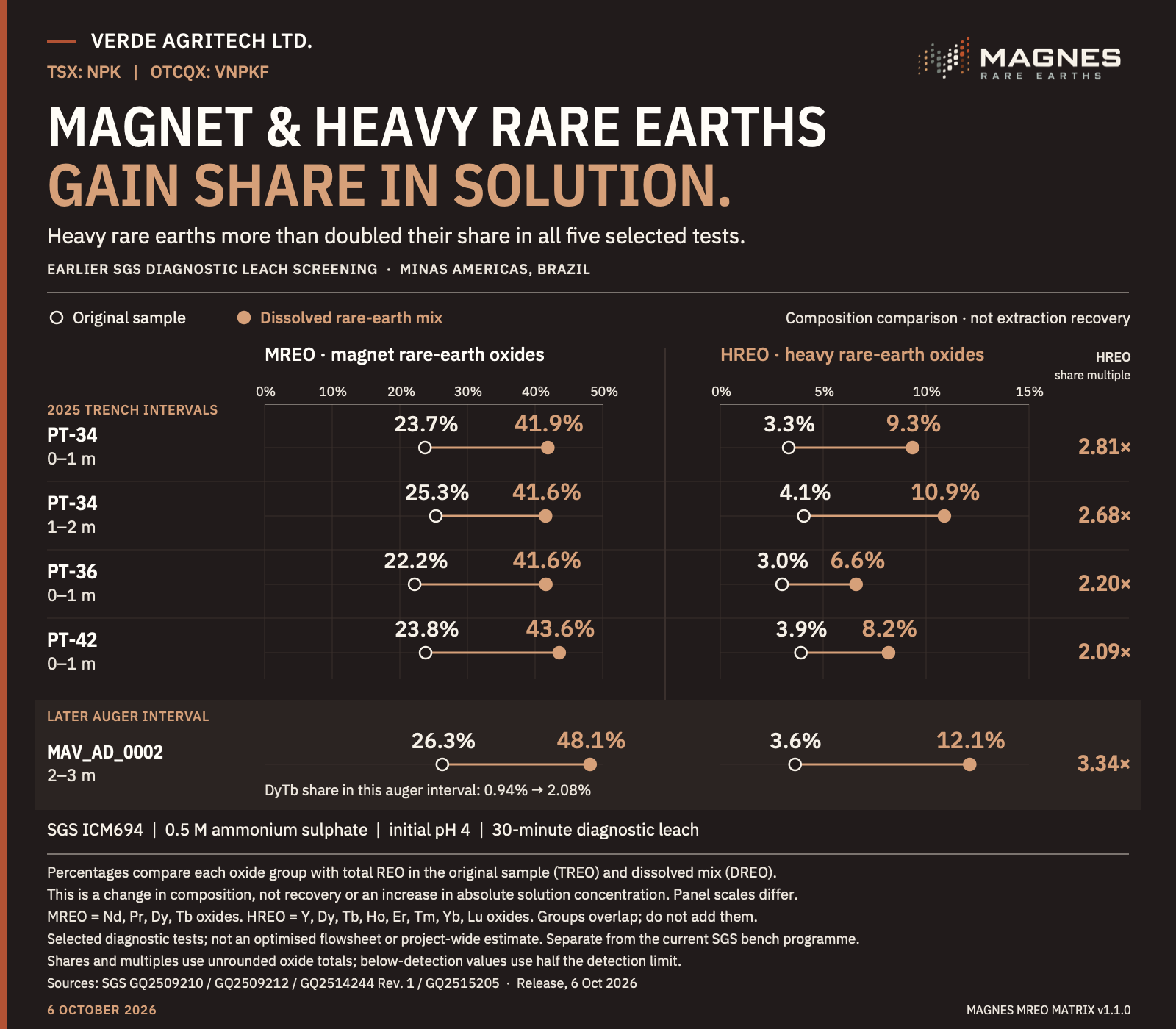
Magnet and heavy rare earths gain share in solution. Figure 2 from the 6 October 2026 release: four selected 2025 trench intervals, plus a later auger interval. HREO represented 6.6–12.1% of the dissolved rare-earth mix, compared with 3.0–4.1% in the original samples.
These are composition shares, not extraction recovery or an increase in absolute solution concentration. MREO and HREO overlap through DyTb and must not be added. Selected diagnostic tests are separate from the current SGS bench programme and do not establish an optimised flowsheet or project-wide recovery.
Read the graphic values as a table
| Selected interval | MREO · original | MREO · dissolved | HREO · original | HREO · dissolved | HREO share multiple |
|---|---|---|---|---|---|
| PT-34 · 0–1 m | 23.7% | 41.9% | 3.3% | 9.3% | 2.81× |
| PT-34 · 1–2 m | 25.3% | 41.6% | 4.1% | 10.9% | 2.68× |
| PT-36 · 0–1 m | 22.2% | 41.6% | 3.0% | 6.6% | 2.20× |
| PT-42 · 0–1 m | 23.8% | 43.6% | 3.9% | 8.2% | 2.09× |
| MAV_AD_0002 · 2–3 m (later auger) | 26.3% | 48.1% | 3.6% | 12.1% | 3.34× |
Later auger interval DyTb share: 0.94% → 2.08%. Shares and multiples use unrounded oxide totals; below-detection values use half the detection limit. SGS ICM694: 0.5 M ammonium sulphate, initial pH 4, 30 minutes. MREO comprises Nd, Pr, Dy and Tb oxides; HREO comprises Y, Dy, Tb, Ho, Er, Tm, Yb and Lu oxides. The graphic panels use different scales.
Diagnostic composition · October source basis
These are the five selected historical diagnostic intervals, not the seven geological samples in the separate SGS bench-scale programme. Values describe desorbed oxide equivalents on the laboratory mg/kg reporting basis—not increased absolute solution concentration or recovery.
| Interval | MREO (mg/kg) | DREO (mg/kg) | MREO share of DREO |
|---|---|---|---|
| PT-34 · 0–1 m | 161 | 384 | 41.9% |
| PT-34 · 1–2 m | 240 | 578 | 41.6% |
| PT-36 · 0–1 m | 278 | 667 | 41.6% |
| PT-42 · 0–1 m | 167 | 383 | 43.6% |
| MAV_AD_0002 · 2–3 m | 237 | 492 | 48.1% |
The October source reports PT-34 0–1 m DREO using half detection limits; the reconciled figure is shown above, while the earlier graphic remains unchanged in the dated archive below. MREO and HREO overlap through DyTb and must not be added. Composition is not extraction recovery or commercial process performance.
Historical diagnostic graphic and technical plate · original reporting basis
This is the unchanged earlier illustration, not the October source table or the new SGS bench results. Its original reporting basis must be read in that dated context.
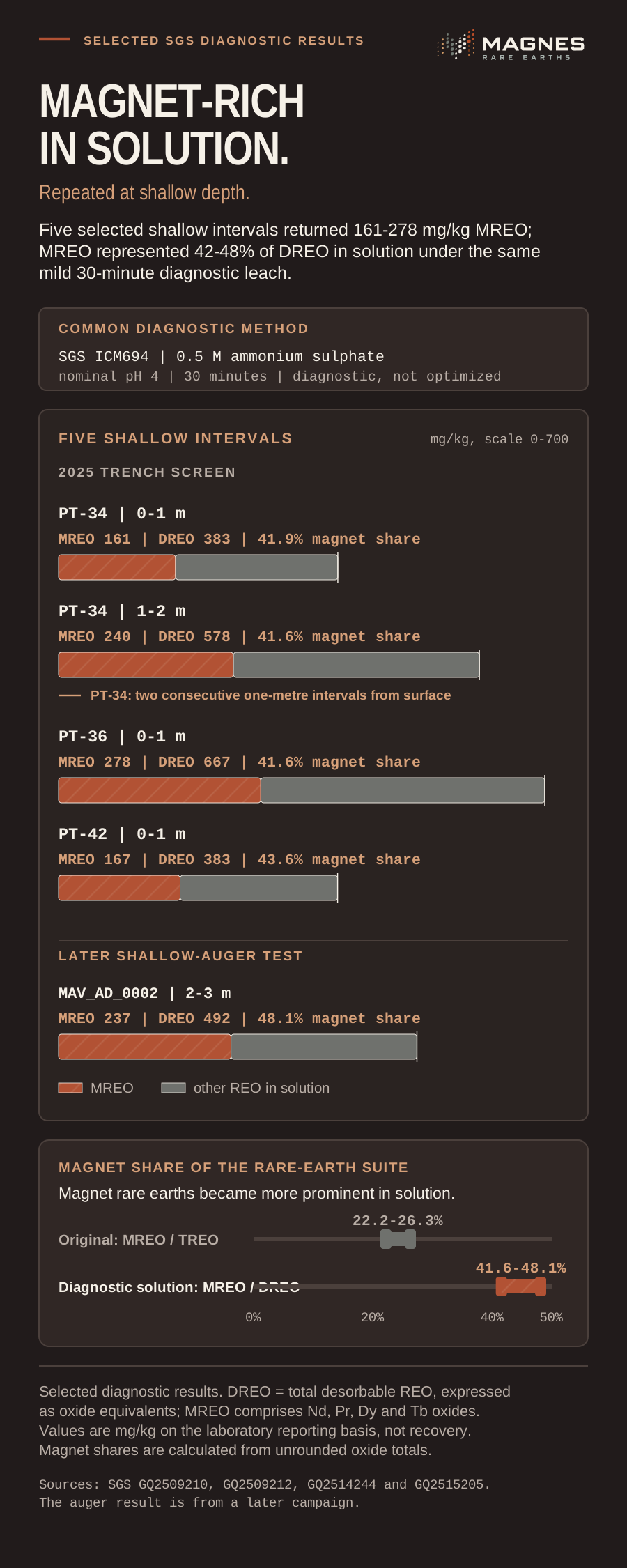
Accessible data transcript (HTML)
Five selected shallow intervals tested using SGS ICM694: 0.5 M ammonium sulphate, nominal pH 4 and 30 minutes.
| Interval | MREO in solution | DREO in solution | MREO share of DREO |
|---|---|---|---|
| PT-34 · 0-1 m | 161 mg/kg | 383 mg/kg | 41.9% |
| PT-34 · 1-2 m | 240 mg/kg | 578 mg/kg | 41.6% |
| PT-36 · 0-1 m | 278 mg/kg | 667 mg/kg | 41.6% |
| PT-42 · 0-1 m | 167 mg/kg | 383 mg/kg | 43.6% |
| MAV_AD_0002 · 2-3 m | 237 mg/kg | 492 mg/kg | 48.1% |
Selected diagnostic results, not optimised or representative recovery tests. Values are solution concentrations, not recovery percentages. MREO comprises Nd, Pr, Dy and Tb oxides; DREO is expressed on an oxide-equivalent basis.
分析値から有価性まで
岩石から収益までの5つの異なる指標。
各段階は、何が存在するかから、何を回収・製造・販売できるかまで、それぞれ異なる問いに答えます。
- 01
ヘッド品位
処理前の元の固体試料に含まれる量。6月の掘削結果はヘッド品位分析です。
- 02
診断溶液の結果
一つの所定試験で溶解した量。選定された2025年の作業はこの段階に該当します。
- 03
抽出率または脱着率
試料質量、溶液量およびマスバランスに裏付けられ、元の含有量から溶液へ移行した割合。
- 04
フローシート全体の回収率
損失およびリサイクル流を含む各工程段階を経て、規定製品に到達する割合。
- 05
有価回収率
仕様、不純物および商業上の控除後に顧客が対価を支払う部分。
元の試料質量、溶液量、固液比および完全なマスバランスがなければ、固体のヘッド分析値と溶液中mg/kgで報告された濃度を割り算して回収率を算出することはできません。
Dated translated context · issued-source chapter through 8 September 2026
各プロセス流
フローシートの全体像を構築する。
代表性のある試験では、原料、溶液、残渣、損失および選定した製品化ルートにわたり、レアアースと不純物を照合します。
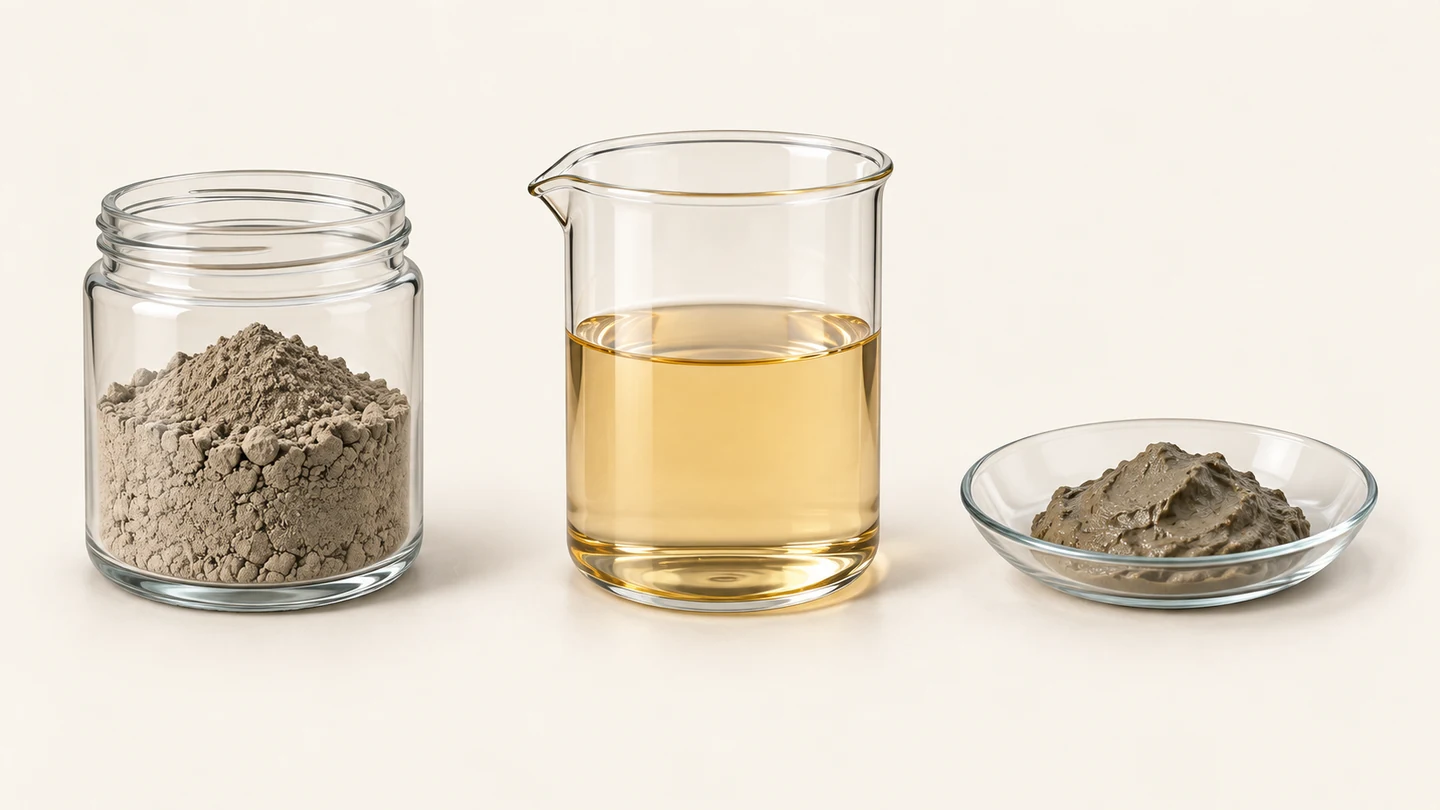
実験室で分けて扱う試料・溶液・残渣の概念図です。試験結果や量を示すものではなく、回収率を立証するものでもありません。
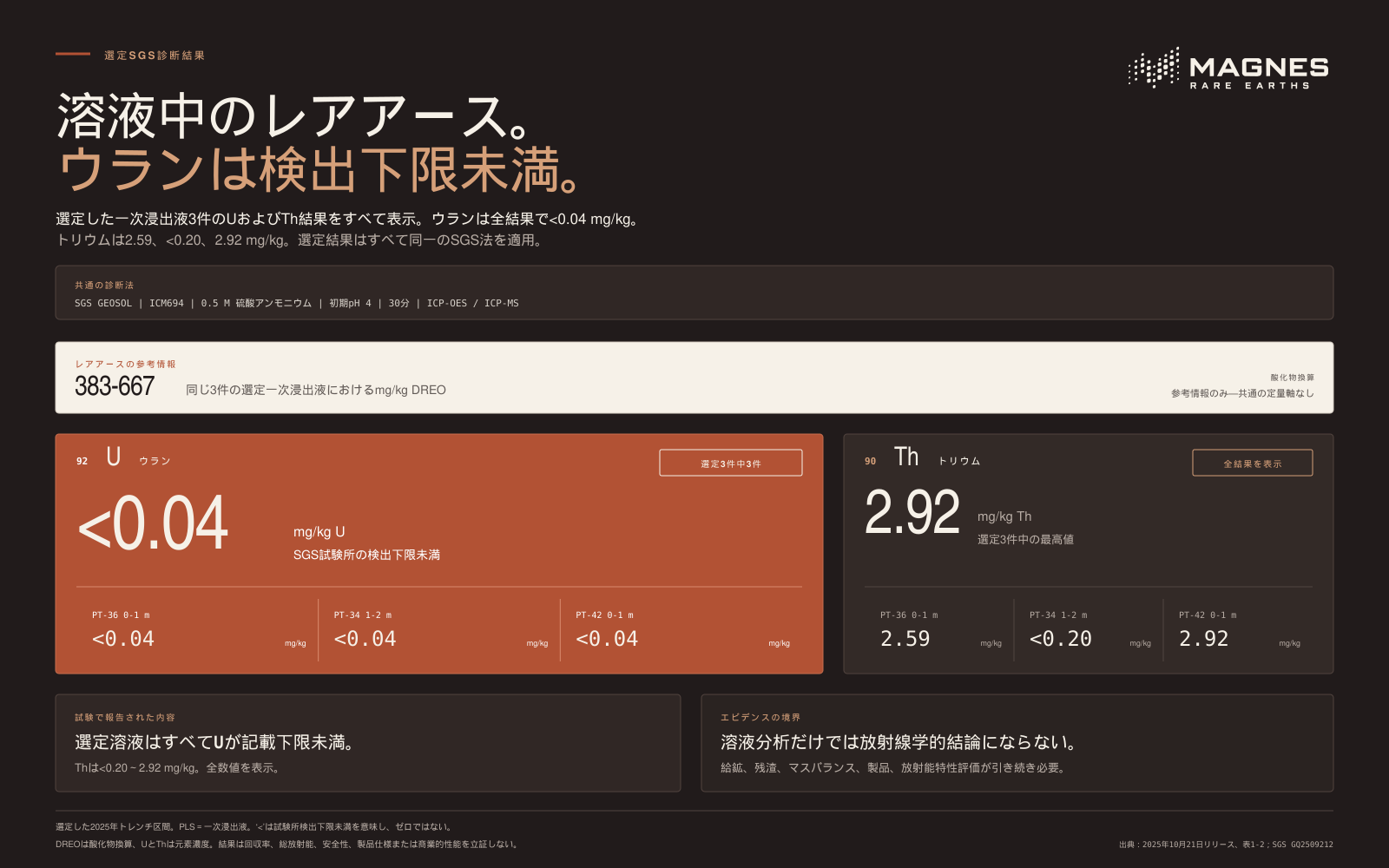
アクセシビリティ対応のデータ書き起こし(HTML)
選定されたSGS ICM694一次浸出液結果:0.5 M硫酸アンモニウム、初期pH 4、30分。
| 区間 | PLS中DREO | ウラン | トリウム |
|---|---|---|---|
| PT-36 · 0-1 m | 667 mg/kg | <0.04 mg/kg U | 2.59 mg/kg Th |
| PT-34 · 1-2 m | 578 mg/kg | <0.04 mg/kg U | <0.20 mg/kg Th |
| PT-42 · 0-1 m | 383 mg/kg | <0.04 mg/kg U | 2.92 mg/kg Th |
「<」記号はSGSラボ検出限界未満を意味し、ゼロではありません。DREOは酸化物換算値、UとThは元素濃度です。 選定された診断溶液結果であり、鉱物資源量の平均値でも、代表性のある放射性元素データセットでもありません。これらの濃度は、原料、残渣、水、作業環境、潜在的製品、または鉱区全体のウラン・トリウムを特徴付けるものではなく、移行、回収率、マスバランス、総放射能、製品仕様、環境安全性、商業的性能を確立するものでもありません。
放射性物質に関するエビデンス
放射性物質に関する全体像を構築する。
選定された2025年の一次浸出液3件では、全結果でウランが0.04 mg/kg未満、トリウムが2.59 mg/kg、0.20 mg/kg未満、2.92 mg/kgと報告されました。
次の段階は、完全なマスバランスおよび適切な放射性物質測定を伴う、代表性のある原料–溶液–残渣–製品の特性評価です。
製品への道筋
まず製品を定義する。その後、顧客が使用できるかを検証する。
信頼性のある製品構想を構築するには、代表性のある鉱物学的特性、元素別抽出率、不純物挙動およびマスバランスを先に確立する必要があります。
その後に初めて、Magnesと潜在的パートナーは、精製、分離、認定、実現価格、資本および操業への影響を評価できます。
関連能力について協議する投資仮説
冶金が投資仮説をどう変えるかを見る。
代表性のある回収率、不純物および製品定義が、地質結果のうち商業的に意味を持ち得る部分を決定します。
投資仮説を変える要因を見る